
Land Cruiser Prado vs Mitsubishi Pajero: Two Legends, One Still in Its Prime
One won the Dakar Rally again and again. The other built a reputation for never breaking down. In Ireland both are more likely to tow a horsebox, and the right choice depends on age and appetite.
By the Japan to Ireland editors · · 4 min read
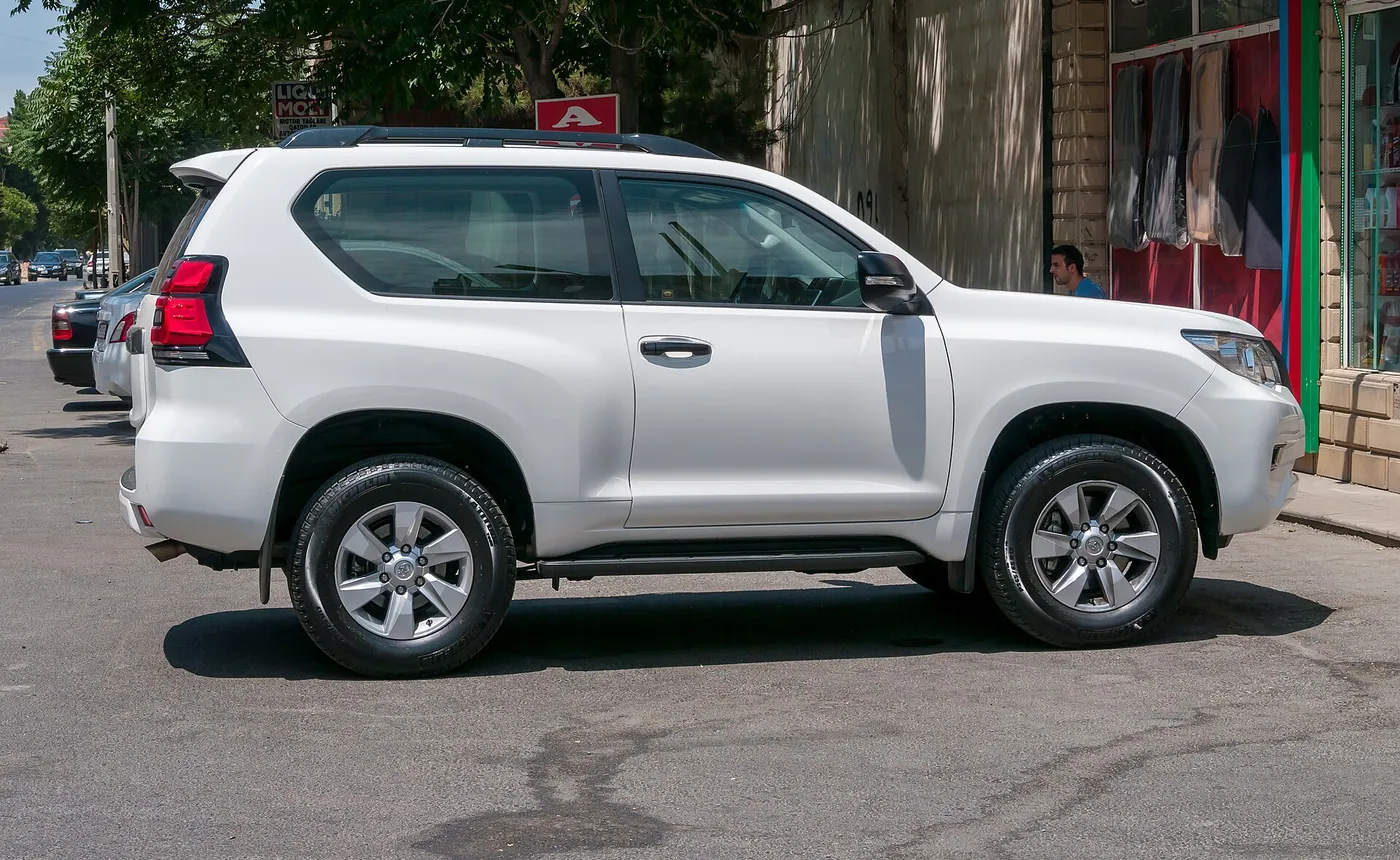

In short: In the three months to 19 September 2026, 4,424 Toyota Land Cruiser Prados sold at Japanese auctions at a median of €19,243, against 533 Mitsubishi Pajeros at €3,413. The Mitsubishi Pajero is the cheaper buy by about €15,830 at auction, before shipping, VAT, VRT and fees. Our verdict is at the end of this article.
Few vehicles carry their reputations as heavily as these two. The Mitsubishi Pajero, sold in Britain as the Shogun, built its name in the Sahara, winning the Dakar Rally more often than any other model. The Toyota Land Cruiser Prado earned its standing more quietly, as the vehicle aid agencies, farmers and mining crews bought because it kept going.
In Japan, both were sold to families who wanted a big four-wheel drive for ski trips and long weekends. The generations most common at auction today are the J150 Prado, built from 2009 and updated several times, and the fourth-generation Pajero, which began in 2006 and was withdrawn from the Japanese market in 2019.
On paper they compete. In practice the Prado is a newer, more refined vehicle that was still being built until 2024, while the Pajero is an older design approaching the end of its useful supply. That shapes everything else.
The specs
| Toyota Land Cruiser Prado | Mitsubishi Pajero | |
|---|---|---|
| Generation most imported | J150, 2009–2024 | 4th gen (V80/V90), 2006–2019 |
| Engines | 2.7 petrol, 2.8 turbo diesel from 2015 | 3.0 and 3.8 V6 petrol, 3.2 turbo diesel |
| Gearbox | Automatic | Automatic, some manuals |
| Drive | Full-time 4WD with low range | Super Select 4WD with low range |
| Seats | 5 or 7 | 4 or 5 (3-door), 7 (5-door) |
| Construction | Separate ladder chassis | Monocoque with built-in frame |
| Body styles in Japan | 5-door | 3-door and 5-door |
| Import duty to Ireland | 0% possible (Japan-built, with proof of origin) | 0% possible (Japan-built, with proof of origin) |
Two kinds of toughness
The Prado is built the traditional way, with a separate ladder chassis carrying the body. That construction shrugs off abuse and makes heavy towing straightforward. Its full-time four-wheel drive has a low-range transfer box, and many versions add electronic aids that manage wheelspin on mud, sand or loose rock.
The Pajero uses a monocoque body with a frame built into it, a design that saves weight and improves its manners on the road. Its Super Select system lets the driver run in rear-wheel drive on dry tarmac, full-time four-wheel drive in the wet, and locked four-wheel drive with low range when the going gets serious. It is a clever arrangement and, for most Irish use, it is more than enough.
On the road
The Prado is large and it does not hide its weight. The ride is soft, there is body roll through bends and the steering is light and slow. On a motorway it is quiet and stable, a good place to spend three hours. The 2.8-litre diesel introduced in Japan in 2015 is the engine to look for: strong from low revs and much more economical than the 2.7 petrol.
The Pajero feels lighter and more alert. The short-wheelbase three-door is genuinely nimble, with a tight turning circle that suits narrow farmyards. The 3.2-litre diesel pulls well but clatters; the V6 petrol engines are smooth and thirsty. At speed it is noisier than the Prado, with more wind and road roar.
Inside
The Prado's cabin is well built, with a commanding driving position, a comfortable middle row and a third row that folds into the boot floor on seven-seat versions. Upper grades carry leather, heated seats and a long list of equipment.
The Pajero's interior shows its 2006 origins in hard plastics and older switchgear, but the seats are supportive and the five-door has a usable third row. The three-door is best treated as a four-seater with a short boot, ideal for a couple with dogs.
Running costs and reliability
Neither is cheap to run. Both sit in high CO2 bands, so motor tax is substantial, and the petrol versions are heavy drinkers. Insurance for younger drivers can be steep.
The Prado's reliability record is excellent. Its 2.8 diesel uses a particulate filter that needs regular longer runs to regenerate, so it suits rural and motorway driving better than short city hops. The Pajero is also durable, but most examples are now older and higher in mileage, and the 3.2 diesel can suffer from injector and turbo wear.
What to check at auction
For both, read the auction sheet's comments on the underside. Vehicles from snowy prefectures may show rust on the chassis, suspension arms and brake lines, and it is worth paying more for one that has none. Look for evidence of hard off-road use: scraped sills, dented underbody protection and repaired body panels.
For the Prado, check for exhaust smoke from the diesel and any notes on warning lights. For the Pajero, make sure the Super Select system engages each mode cleanly and listen for noise from the transfer case. Many Pajeros carry aftermarket bull bars, raised suspension and roof racks, which can complicate the NCT.
The verdict
Buy the Toyota Land Cruiser Prado if you want the stronger long-term proposition: a newer, more refined vehicle with the 2.8 diesel that will tow, climb and carry for many years with routine maintenance.
Buy the Mitsubishi Pajero if you want a capable, characterful four-wheel drive for noticeably less money and accept an older design with higher running costs. A clean three-door is a rare thing, and for the right owner it is a joy.
Frequently asked questions
Is the Mitsubishi Pajero the same as the Shogun?
Yes. The Pajero was sold as the Shogun in Britain and as the Montero in some other markets.
Which Prado engine is best for Ireland?
The 2.8-litre diesel, offered in Japan from 2015. It is stronger at low revs and more economical than the 2.7 petrol.
Is the Pajero still made?
No. Mitsubishi withdrew it from the Japanese market in 2019, so supply of imported examples will only get older.
Keep reading
- Toyota Estima vs Honda Elysion: The Big Family Carriers Japan Has Already Moved On From
- Suzuki Jimny vs Mitsubishi Pajero Mini: Two Tiny Off-Roaders, One Real Climber
- Toyota Ractis vs Nissan Cube: The Sensible Box and the Box With a Personality
- Toyota Corolla Cross vs Honda ZR-V: Two Nearly New Hybrid Crossovers, Two Temperaments
- Toyota Celsior vs Nissan Cima: Japan's V8 Executive Saloons, Twenty Years On
- Importing a Toyota Land Cruiser Prado: prices and costs
Photo credits
- Toyota Land Cruiser Prado: Photo: Matti Blume / Wikimedia Commons, CC BY-SA 4.0
- Mitsubishi Pajero: Photo: Nikolai Bulykin / Wikimedia Commons, CC BY-SA 4.0