
Toyota Celsior vs Nissan Cima: Japan's V8 Executive Saloons, Twenty Years On
The Celsior was the Japanese-market Lexus LS. The Cima was Nissan's answer, sold abroad as the Infiniti Q45. Both carried big V8s and Japan's idea of luxury into the 2000s.
By the Japan to Ireland editors · · 4 min read

In short: In the three months to 19 September 2026, 392 Toyota Celsiors sold at Japanese auctions at a median of €2,865, against 190 Nissan Cimas at €1,399. The Nissan Cima is the cheaper buy by about €1,465 at auction, before shipping, VAT, VRT and fees. Our verdict is at the end of this article.
In the late 1980s, at the height of Japan's economic boom, Toyota and Nissan each decided to build a saloon that could stand beside the best of Germany. Toyota's was the Celsior, sold abroad from 1989 as the Lexus LS. Nissan's was the Cima, a car that grew into the basis of the Infiniti Q45. For two decades these were the cars of company presidents, senior civil servants and families who had done well.
The Celsior ended in 2006, when the Lexus brand opened in Japan and the LS took its place. The Cima carried on in various forms for longer. At Japanese auctions today, the most common examples are the third-generation Celsior, sold as the UCF30 and UCF31 from 2000 to 2006, and the F50 Cima of 2001 to 2010. Both are rear-drive V8 saloons, and both are now old enough to be cheap but not yet old enough to be treated as classics.
The specs
| Toyota Celsior | Nissan Cima | |
|---|---|---|
| Generation most imported | 3rd gen (UCF30/31), 2000–2006 | F50, 2001–2010 |
| Engine | 4.3 V8 (3UZ-FE) | 4.5 V8 (VK45DD direct injection) |
| Power | 280 PS | 280 PS |
| Gearbox | 5-speed, later 6-speed automatic | 5-speed automatic |
| Drive | Rear | Rear |
| Seats | 5 | 5 |
| Export name | Lexus LS430 | Infiniti Q45 |
| Import duty to Ireland | 0% possible (Japan-built, with proof of origin) | 0% possible (Japan-built, with proof of origin) |
History and positioning
The UCF30 Celsior arrived in 2000 with a 4.3-litre V8, the 3UZ-FE, and abroad it was the Lexus LS430. A facelift in 2003 brought a six-speed automatic in place of the five-speed. Higher grades offered air suspension and, in the most lavish versions, reclining rear seats with their own controls. It was built with an obsessive attention to detail that defined Toyota at its peak.
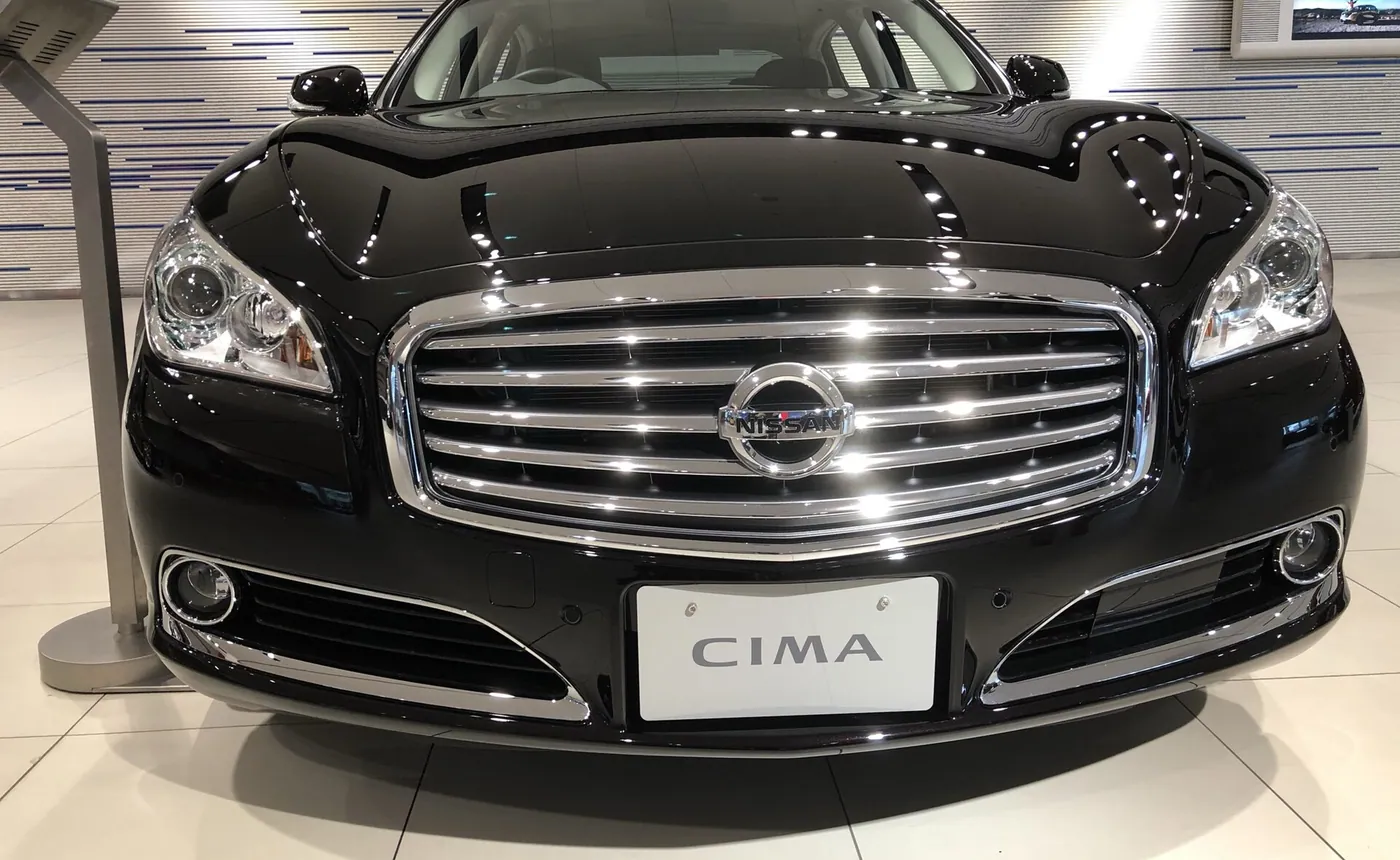
The F50 Cima appeared in 2001 with a 4.5-litre V8 using direct petrol injection, which was advanced for its day. Abroad, it was the Infiniti Q45. Its styling was bolder than the Toyota's, with a tall grille and headlamps made up of several small lenses, and it carried a long list of electronic equipment.
How they drive
The Celsior is famous for its smoothness. At idle the V8 is almost inaudible, and at motorway speed the cabin is quieter than many modern cars. The ride is soft and long-legged, swallowing expansion joints on the M1 without comment. It is not a sporting car. It leans in corners and the steering is light, but it never feels clumsy.
The Cima is a shade firmer and more willing. Its engine has a little more character and the car feels happier being driven briskly along an N-road. It remains, however, a big, heavy, comfortable saloon, and neither car is at its best on a narrow boreen with grass up the middle.
Inside and practicality
The Celsior's interior shows its quality two decades on. The leather is thick, the wood is real and the switches still click with precision. Rear passengers are especially well treated, and the boot is large and regular in shape.
The Cima's cabin is similarly lavish, with deep seats and plenty of room in the back. Its electronic displays and navigation look dated now, and some of its gadgets may no longer work, which matters less than the quality of the seats and the quietness of the ride.
Running costs and reliability
These are big V8 saloons, so fuel consumption is high and both sit in high CO2 bands for motor tax. The 3UZ-FE engine has a reputation for durability, with a timing belt that must be replaced at the recommended interval. The Celsior's air suspension, where fitted, will eventually leak with age, and many owners convert to conventional springs.
The Cima's direct-injection V8 is more complex. Carbon build-up and injector problems are known, and the engine is less forgiving of neglect. Parts for both cars can take longer to source than for mainstream models, though the LS430 link gives the Celsior a large overseas parts and knowledge base. The Infiniti Q45 connection helps the Cima to a lesser degree.
What to check at a Japanese auction
Many of these cars passed through a period in Japan when large saloons were lowered, fitted with big wheels and body kits. Original, unmodified cars are scarcer and worth more. Read the auction sheet for rust notes, particularly around the wheel arches, sills and under the boot floor, and for any signs of accident repair.
On a Celsior, check whether the car has air suspension and whether the inspector noted it sitting low. On a Cima, look for notes on rough running or engine warning lights. Ask for maintenance records, especially for the timing belt on the Toyota. Realistic grades for cars of this age are 3.5 to 4.
The verdict
Buy the Toyota Celsior if you want a supremely comfortable, durable V8 saloon with a cabin that has aged better than almost anything else of its era. For most buyers it is the safer, more rewarding choice.
Buy the Nissan Cima if you want something rarer and more distinctive, enjoy its bolder styling and are prepared to look after a more demanding engine. It is the car for an enthusiast who likes being the only one in the car park.
Frequently asked questions
Is the Celsior the same as the Lexus LS?
Yes. The Celsior was the Japanese-market version of the Lexus LS. The UCF30 generation was sold abroad as the LS430.
Was the Cima sold outside Japan?
Yes. The F50 Cima was sold in other markets as the Infiniti Q45.
Which is more reliable?
The Celsior's 3UZ-FE V8 has the stronger reputation. The Cima's direct-injection V8 needs more care.
Are they expensive to run?
Yes. Both have large V8 engines, high fuel consumption and high CO2 bands for motor tax.
Keep reading
- Lexus LS vs Mercedes-Benz S-Class: The Flagship Duel, Bought From Japan
- Toyota Crown Crossover vs Lexus ES: The Saloon That Grew Tall and the One That Stayed Low
- Nissan Teana vs Toyota Premio: Two Quiet Japanese Saloons for Drivers Who Hate Fuss
- Toyota Allion vs Nissan Bluebird Sylphy: The Quiet Saloons Japan Kept for Itself
- Toyota Supra vs Nissan Fairlady Z: Two Old Names, Two Very Different Ideas of a Sports Car
Photo credits
- Toyota Celsior: Photo: Damian B Oh / Wikimedia Commons, CC BY-SA 4.0
- Nissan Cima: Photo: SF godzilla lover / Wikimedia Commons, CC BY-SA 4.0