
Toyota Crown Crossover vs Lexus ES: The Saloon That Grew Tall and the One That Stayed Low
Toyota rebuilt its oldest nameplate as a raised, four-wheel-drive hybrid. Lexus kept the ES long, low and hushed. They share a platform and very little else in spirit.
By the Japan to Ireland editors · · 4 min read
In short: In the three months to 19 September 2026, 458 Toyota Crown Crossovers sold at Japanese auctions at a median of €19,980, against 443 Lexus ESs at €18,474. The Lexus ES is the cheaper buy by about €1,506 at auction, before shipping, VAT, VRT and fees. Our verdict is at the end of this article.
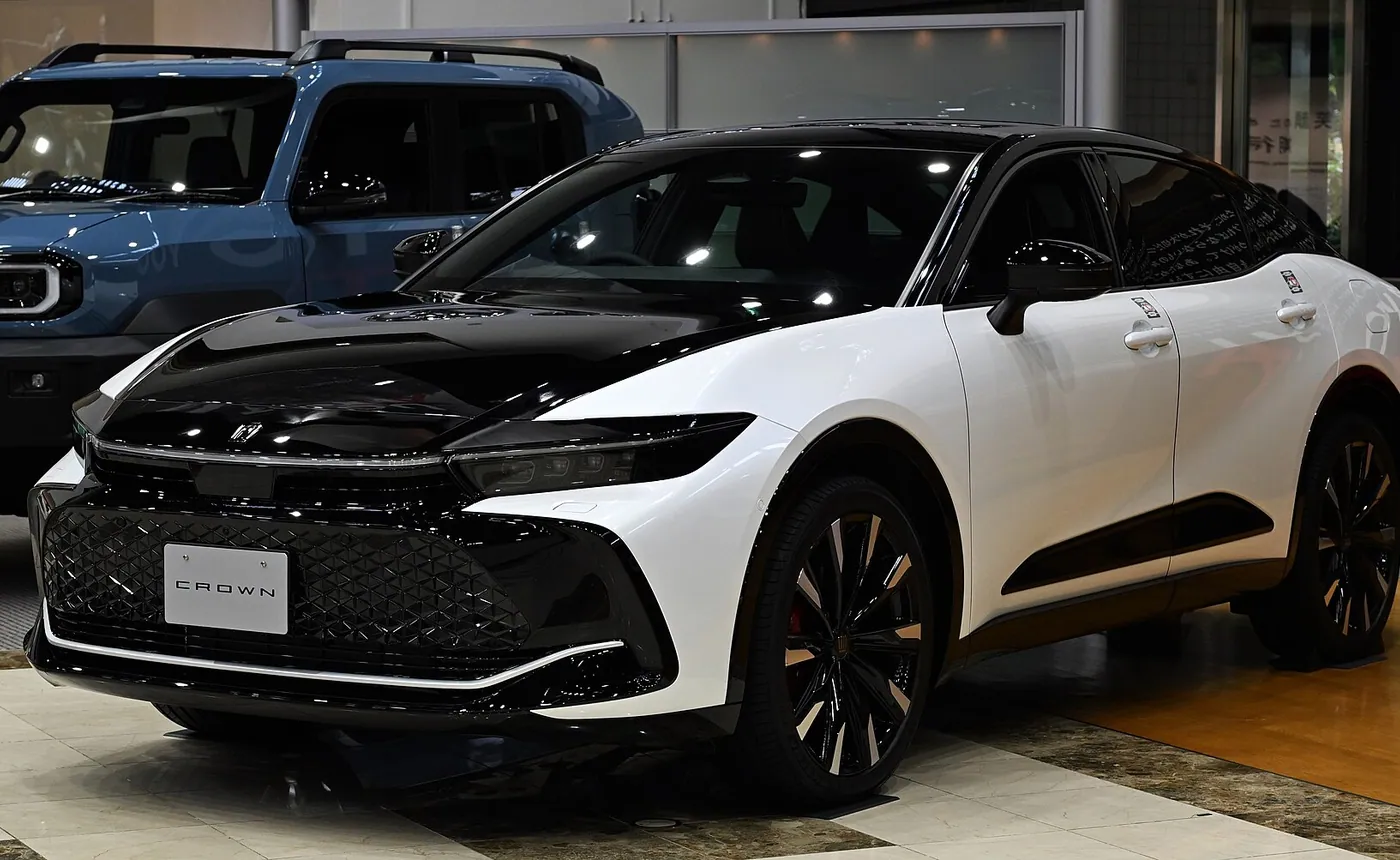
For almost seventy years the Toyota Crown meant one thing in Japan: a large, rear-drive saloon in dark paint, waiting outside a hotel with its engine idling and a driver in white gloves. Then, in 2022, Toyota did something few car companies dare to do with a sacred name. It launched the sixteenth-generation Crown first as the Crossover, a hybrid saloon on raised suspension with four-wheel drive and, if you wanted it, a two-tone paint scheme with a black bonnet.
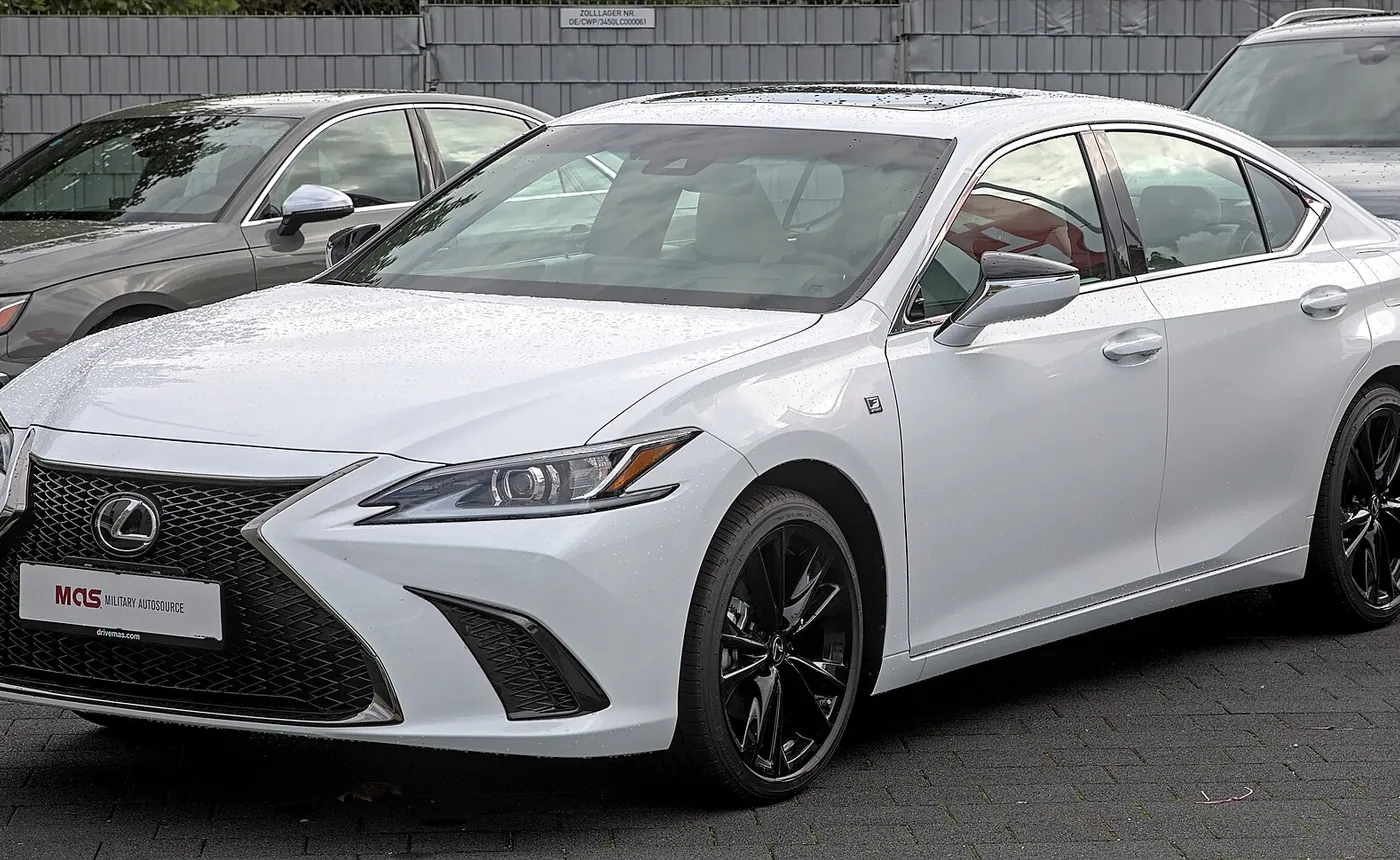
The Lexus ES went the other way. The seventh generation, which reached Japan in late 2018, is long, low, front-wheel drive and deliberately calm. It was the first ES ever sold in its home market, having spent most of its life as a comfortable saloon for American buyers.
Underneath, the two share Toyota's GA-K platform and the same family of hybrid hardware. On paper they are cousins. On the road, and in what they say about their owners, they are very different cars, and both now appear at Japanese auctions in good numbers.
The specs
| Toyota Crown Crossover | Lexus ES | |
|---|---|---|
| Generation most imported | 16th-gen Crown Crossover, 2022 on | 7th gen ES, Japan from 2018 |
| Engine(s) | 2.5 hybrid; 2.4 turbo hybrid (RS) | 2.5 hybrid (ES300h) |
| System output | 234 PS (2.5); 349 PS (2.4 turbo) | 218 PS |
| Gearbox | e-CVT (2.5); 6-speed automatic (2.4 turbo) | e-CVT |
| Drive | AWD (E-Four) | Front |
| Seats | 5 | 5 |
| Length | 4,930 mm | 4,975 mm |
| Platform | GA-K | GA-K |
| Import duty to Ireland | 0% possible (Japan-built, with proof of origin) | 0% possible (Japan-built, with proof of origin) |
Two answers to one question
The question both cars answer is how to make a large hybrid saloon feel special. The ES answers with refinement. In Japan it came only as the ES300h, with a 2.5-litre four-cylinder hybrid driving the front wheels, and it was facelifted in 2021 with a touchscreen and sharper detailing. Some Japanese Version L cars were offered with camera-based door mirrors that show the view on small screens inside the cabin, an odd and memorable feature.
The Crown Crossover answers with presence. The standard car uses a 2.5-litre hybrid with E-Four electric all-wheel drive, while the RS has a 2.4-litre turbocharged hybrid with a conventional six-speed automatic and considerably more power. It sits higher than an ordinary saloon but nowhere near as high as an SUV.
How they drive
The ES is one of the quietest cars in its class. The hybrid system pulls away on electric power, the engine joins in without fuss, and at 120 km/h on the M7 the cabin is hushed enough to hear the indicator stalk click. The suspension is soft and well damped, the steering light and accurate. Driven hard on a twisting road it becomes untidy, but it rarely invites you to try.
The Crown Crossover feels more alert. The higher seat gives a clearer view over hedges and traffic, the four-wheel drive gives real reassurance on a wet roundabout, and the RS is properly quick. The ride is firmer than the Lexus's, especially on the 21-inch wheels fitted to many cars, and sharp potholes come through with more of a thud.
Inside and practicality
The ES cabin is classic Lexus: soft leather, deep seats, carefully stitched surfaces and a sense that every switch was tested ten thousand times. Pre-facelift cars use the touchpad controller, which is fiddly; later cars allow you to touch the screen. Rear legroom is outstanding and the boot is a good size, though the opening is narrower than a hatchback's.
The Crown is more modern inside, with a wide central screen, a digital instrument panel and a cleaner layout. Getting in and out is easier thanks to the raised height, which matters to older drivers and to anyone with a bad back. The rear seat is spacious and the boot practical, though neither car folds as flexibly as an estate.
Running costs and reliability
These are Toyota hybrids, and the record of the 2.5-litre system in particular is excellent. The ES is the more frugal of the pair, helped by front-wheel drive and lower weight. The Crown 2.5 is close behind, and the RS uses noticeably more fuel. In VRT and motor tax terms, the 2.5 hybrids sit comfortably lower than the turbo.
Servicing is straightforward at any garage that knows Toyota hybrids, and parts supply is strong because so much is shared with the Camry, RAV4 and other GA-K cars.
What to check at a Japanese auction
Both cars are young, so grade 4 and 4.5 cars with low mileage are the norm. Read the auction sheet for kerbed alloys, which are expensive on the Crown's large wheels, and for stone chips on the long bonnet of the ES. Check the inspector's notes for any panel repairs. Rust is not a realistic concern at this age.
For the Crown, confirm whether the car is a 2.5 or a 2.4 RS, because the auction description sometimes abbreviates grades. For the ES, check the condition of the light-coloured leather that many Japanese cars have, and make sure the digital mirrors, if fitted, work correctly. Ask for the service book on both.
The verdict
Buy the Lexus ES if what you want is silence, comfort and economy over long distances. It is the better car for a driver who spends hours on the motorway and wants to arrive rested, and it is the more traditional luxury experience.
Buy the Crown Crossover if you want something more distinctive, with four-wheel drive, a higher seat and, in RS form, genuine pace. It suits a driver in a wetter, hillier part of the country who wants a big saloon that does not feel like one.
Frequently asked questions
Is the Crown Crossover an SUV?
Not quite. It is a saloon on raised suspension, sitting higher than a normal car but lower than an SUV.
Is the Lexus ES front-wheel drive?
Yes. The ES300h sold in Japan is front-wheel drive only.
Which uses less fuel?
The Lexus ES300h is generally the most frugal. The Crown 2.5 hybrid is close, while the 2.4 turbo RS uses noticeably more.
Do they share parts?
Both use Toyota's GA-K platform and related hybrid components, which helps parts supply.
Keep reading
- Toyota Supra vs Nissan Fairlady Z: Two Old Names, Two Very Different Ideas of a Sports Car
- Toyota GR Yaris vs Subaru WRX STI: The New Rally Hero Meets the Old One
- Lexus LS vs Mercedes-Benz S-Class: The Flagship Duel, Bought From Japan
- Toyota Celsior vs Nissan Cima: Japan's V8 Executive Saloons, Twenty Years On
- Mercedes-Benz V-Class vs Toyota Hiace Wagon: The Executive Shuttle and the Workhorse With Windows
- Importing a Lexus ES: prices and costs
Photo credits
- Toyota Crown Crossover: Photo: TTTNIS / Wikimedia Commons, CC0
- Lexus ES: Photo: Alexander Migl / Wikimedia Commons, CC BY-SA 4.0