
Nissan Skyline GT-R Hakosuka: the boxy saloon that rewrote Japanese racing
The first Skyline GT-R carried a racing engine in a family-car body and won race after race. Genuine cars are rare and copies are everywhere, so here is what to know before you go looking.
By the Japan to Ireland editors · · 4 min read
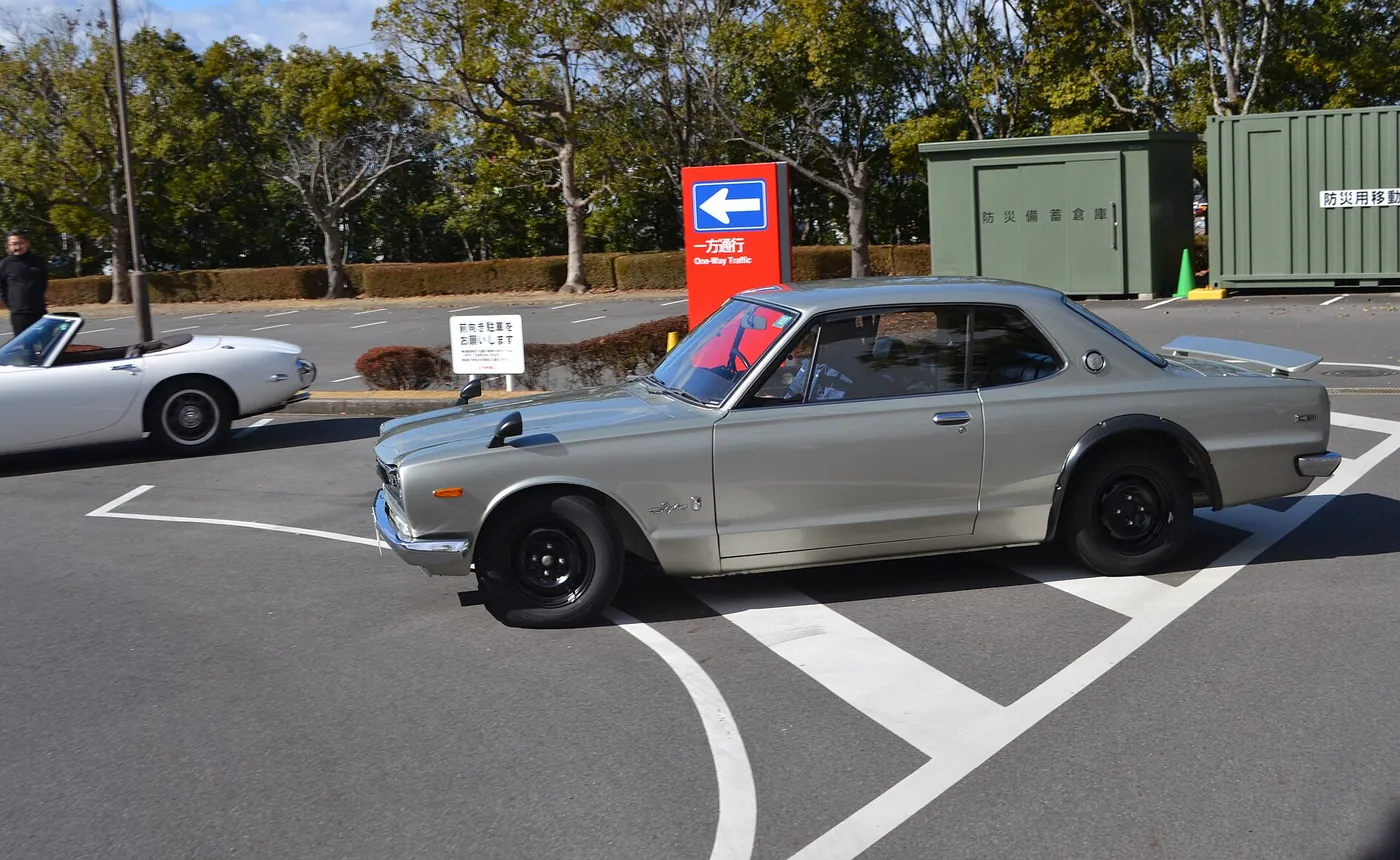
In May 1969, at the JAF Grand Prix at Fuji Speedway, a square-shouldered four-door saloon was declared the winner of the touring car race. It looked like something a salaryman might drive to the office. Under the bonnet sat an engine with direct roots in a Japanese racing prototype, and its victory was the first of a long winning run that turned the Skyline GT-R into a national legend.
Japanese enthusiasts call it the Hakosuka, a contraction of hako, meaning box, and Skyline. The name is affectionate. The car is anything but ordinary.
The specs
| Years built | 1969–1972 |
|---|---|
| Engine | 2.0-litre straight-six (S20), twin overhead camshafts, 24 valves |
| Power | 160 PS (Japanese gross rating) |
| Gearbox | Five-speed manual |
| Drive | Rear-wheel drive |
| Body styles | Four-door saloon (PGC10) and two-door hardtop (KPGC10) |
| Engine origin | Developed from the Prince racing programme |
From Prince to Nissan
The Skyline began life at the Prince Motor Company, a maker with deep engineering ambitions and close links to Japan's pre-war aircraft industry. Prince had gone racing in the 1960s, and its engineers, led on the Skyline by Shinichiro Sakurai, wanted to put racing technology into a road car. In 1966 Prince merged with Nissan, and the Skyline continued under the new owner.
The third-generation Skyline, the C10, arrived in 1968. A year later the GT-R saloon appeared, coded PGC10, and in 1970 the shorter two-door hardtop, the KPGC10, followed. The hardtop is the car most people picture, with its fender-mounted mirrors, cut-back rear wheel arches and simple, upright cabin.
Japan at the time was in the middle of its high-growth years. Car ownership was spreading quickly, the expressway network was expanding and motorsport had become a mass spectator sport. A Skyline that could beat imported machinery on track sold the idea that a Japanese car could be both a family saloon and a racing champion.
The S20 engine
The heart of the car is the S20, a 2.0-litre straight-six with twin overhead camshafts and four valves per cylinder, fed by three twin-choke carburettors. It was developed from the engine of the Prince R380 sports-racing prototype and was rated at 160 PS. In 1969 that was serious output for a two-litre road car, and the engine loved revs.
The rest of the specification was simpler. The body was a modified version of the ordinary Skyline, stripped of weight where possible. Rear suspension was independent by semi-trailing arms, and drive went to the rear wheels through a five-speed manual gearbox. Many GT-Rs were delivered without a radio and with plain trim, because the buyers were expected to care about the engine.
How it drives today
A healthy Hakosuka feels light, narrow and mechanical. The S20 is willing rather than brutal at low revs and comes alive as the needle climbs, with a hard, crisp induction note. The steering has no assistance, the brakes need a firm foot by modern standards, and the cabin is upright with thin pillars and excellent visibility. It is a car that rewards smoothness on a winding road, and it feels at home on a quiet Irish back road, provided the surface is kind to it.
Variants worth knowing
The distinction that matters most is between the real GT-R and everything else. Nissan sold many C10 Skylines with single-cam six-cylinder engines in GT and GT-X form, and four-cylinder versions too. These are good classics in their own right, but they are not GT-Rs. Genuine GT-R production across both body styles was small, generally put at around two thousand cars, with the hardtop the more numerous.
Buying one in Japan
Copies are the central issue. For decades owners have converted ordinary C10 Skylines to GT-R specification, adding the flared arches, the badges and sometimes an S20 or a tuned L-series engine. Some conversions are honest and openly sold as such. Others are not. The chassis plate and registration documents should show the correct GT-R chassis code, and the numbers should be checked carefully against each other and against the history file.
Rust is the second issue. These cars were built from thin steel with little protection. Check the sills, floors, rear wheel arches, boot floor, the area around the front and rear screens, and the bottoms of the doors. Many cars have been restored more than once, and the quality of that work varies widely.
S20 engines are complex and expensive to rebuild, and some parts are now remanufactured. Documentation of engine work is valuable. Mileage on cars of this age is rarely provable, so condition and records count for far more than the odometer.
Should you import one?
A genuine Hakosuka GT-R is a collector car of the highest order, and the realistic route is through a specialist with a verified example. A well-built C10 GT or a properly documented tribute car is a far more attainable way to enjoy the shape and the experience, provided it is sold and registered as exactly what it is.
In Ireland it is right-hand drive and sits comfortably on our roads. As every example is more than 30 years old, it can qualify for Ireland's vintage treatment. Plan for dry storage, agreed-value insurance and a specialist who understands old Nissan sixes. Treat it as a long-term custodianship rather than a car for daily use, and it will repay you.
Frequently asked questions
What does Hakosuka mean?
It is a Japanese nickname combining hako (box) and Skyline, a nod to the C10's square shape.
What engine is in the Hakosuka GT-R?
The S20, a 2.0-litre twin-cam 24-valve straight-six developed from the Prince R380 racing engine.
How can I tell a real GT-R from a copy?
Check the chassis code on the plate and papers, match all numbers, and use a specialist inspection; many ordinary C10s have been converted.
Can a Hakosuka qualify for vintage status in Ireland?
Yes, every example is over 30 years old, so it can qualify for Ireland's vintage treatment.
More Japanese classics
- Toyota 2000GT: the hand-built coupe that told the world Japan could make a supercar
- Nissan Skyline GT-R Kenmeri: the 197-car GT-R that never got to race
- Nissan Skyline R31 GTS-R: the forgotten homologation special that bridged two GT-Rs
- Nissan Skyline GT-R R32: how Godzilla won every race it entered and changed the rules
- All 90 Japanese classics you can import
Photo credits
- Photo: 先従隗始 / Wikimedia Commons, CC0