
Autozam AZ-1: Gullwing Doors, a Mid-Mounted Turbo and Japan's Wildest Kei Car
Mazda's tiny gullwing coupé was the most extreme of the early 1990s kei sports cars. Few were built, and it remains one of the most distinctive Japanese cars of its era.
By the Japan to Ireland editors · · 4 min read
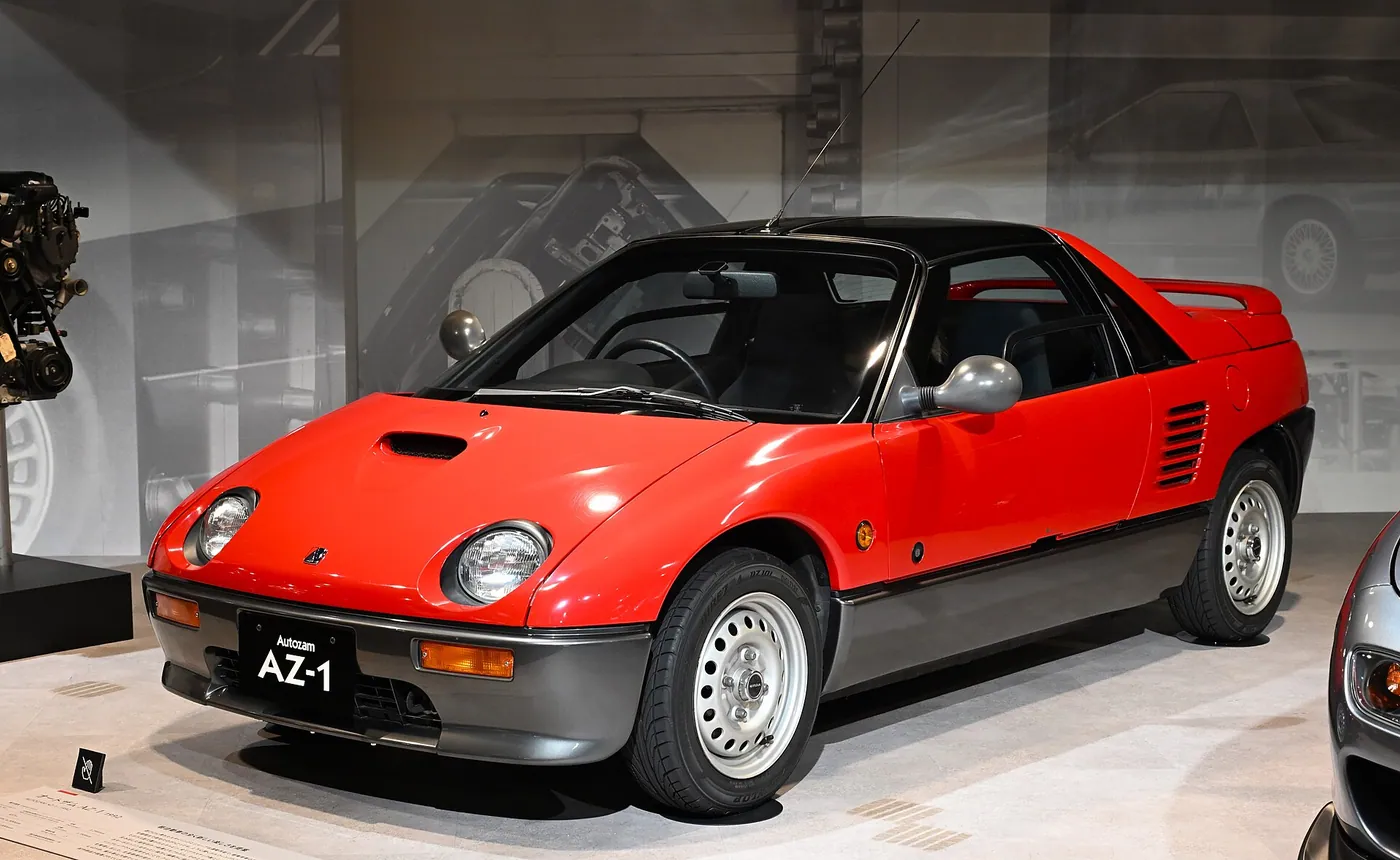
At the Tokyo Motor Show of 1989, at the height of Japan's bubble economy, Mazda showed three small concept cars under the name AZ550 Sports. One of them, with gullwing doors and a mid-mounted engine, looked like a scale model of a supercar. Three years later, a production version reached Japanese showrooms. The world's most dramatic kei car was real.
It was sold as the AZ-1 under Autozam, one of several sales channels Mazda created in the late 1980s, and it is still one of the most unusual production cars ever made in Japan.
The specs
| Years built | 1992–1994 |
|---|---|
| Engine | 657 cc three-cylinder turbo (Suzuki F6A) |
| Power | 64 PS |
| Gearbox | 5-speed manual |
| Drive | Rear-wheel drive, mid-engine |
| Body styles | 2-seat coupé with gullwing doors |
| Construction | Steel frame with plastic outer body panels |
| Sister car | Suzuki Cara |
Why Mazda built it
The late 1980s was a time of extraordinary optimism and spending in Japan. Mazda had expanded into several new brands, including Eunos and Autozam, and it was keen to make a statement in every segment. The kei class was about to receive new rules in 1990, allowing 660 cc engines and slightly longer bodies, and it offered a chance to build something small, affordable and exciting.
Suzuki, already a partner of Mazda in small vehicles, supplied the engine and was closely involved in the project. By the time the AZ-1 arrived in 1992, the bubble economy had burst, and buyers were far more cautious than when it was planned.
Design and engineering
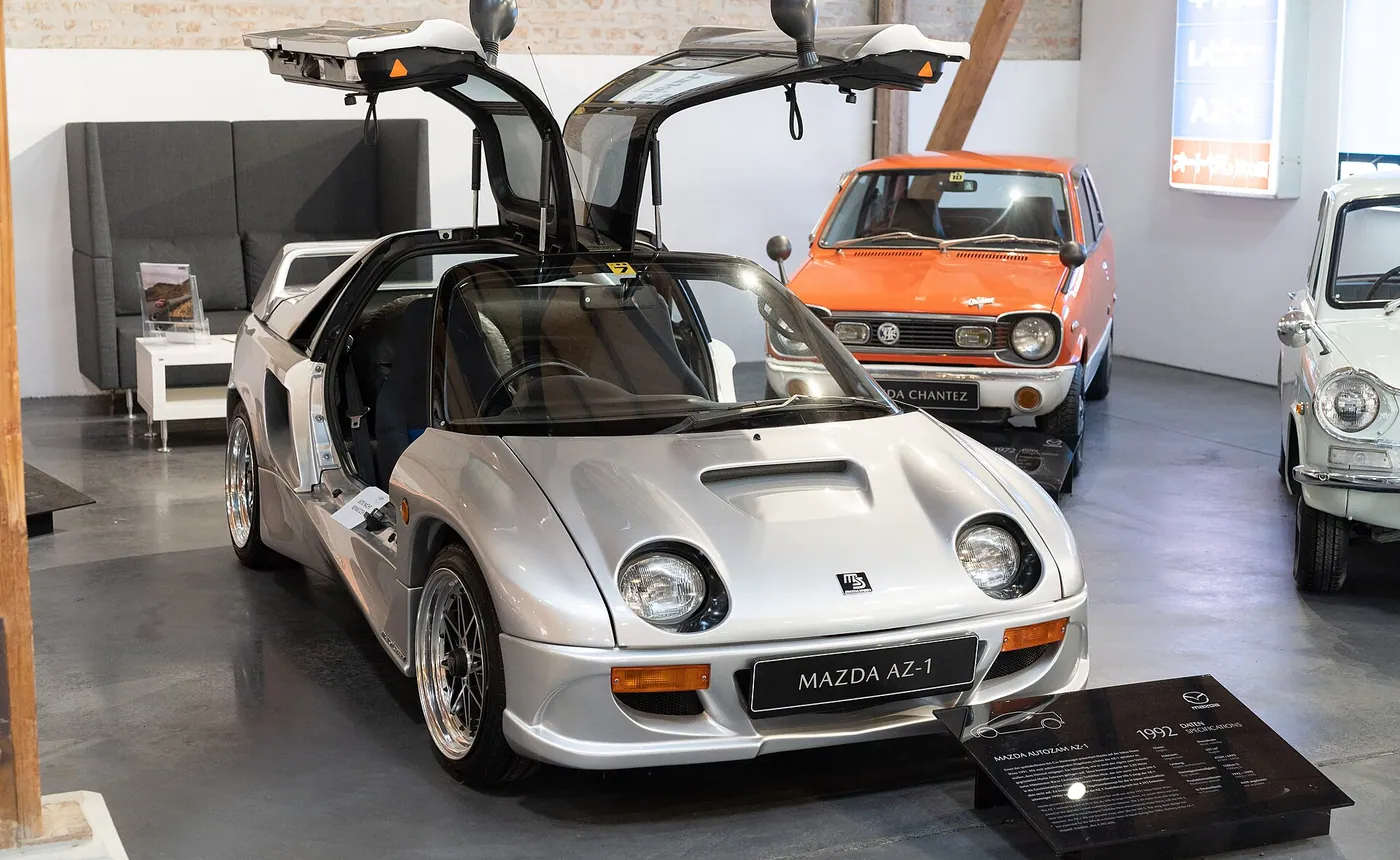
The AZ-1 is built around a steel frame, with outer body panels made of plastic. The gullwing doors include small fixed windows with a little sliding section, and the cabin sits under a glass canopy. The engine is Suzuki's 657 cc F6A three-cylinder turbo, as used in the Alto Works and Cappuccino, mounted transversely behind the seats and driving the rear wheels through a five-speed manual gearbox. Like other kei cars of the time, it was rated at 64 PS.
The car is very low and very light, with a short wheelbase and a reputation for extremely quick, unassisted steering. Suzuki sold its own version, the Cara, with minor differences. Production was short, and only a few thousand AZ-1s were built in total.
How it drives today
The AZ-1 is not a relaxed car. You climb in over a wide sill and sit very low, with the engine just behind your head. The steering is extremely quick and the car responds to the smallest input. The mid-engine layout and short wheelbase make it agile, but it demands respect at the limit, especially on wet or uneven roads.
On Irish roads, the AZ-1 feels like a go-kart with a roof. It is noisy, cramped and hot in summer, but it is enormous fun on a dry, smooth road. Motorway driving is possible, but the car's size and low profile make it feel vulnerable beside larger vehicles.
The versions worth knowing
The standard AZ-1 is the core model. Mazdaspeed offered a version with an aero kit and other upgrades, and those cars are highly prized. The Suzuki Cara is mechanically very similar and is an alternative for buyers who are more concerned with the driving experience than the badge. Many cars were also fitted with Mazdaspeed or aftermarket parts after they were sold, so a genuine factory Mazdaspeed car should be checked carefully.
What to look for when buying one in Japan
The steel frame can rust, especially at the sills, floor, door hinge areas and under the front and rear of the car. Because the outer panels are plastic, corrosion can hide underneath them. Water leaks around the glass canopy and door seals are common and can lead to damp carpets and hidden rust. Check the gullwing doors carefully: they should open smoothly and stay up, and the gas struts and hinges should be in good order.
The engine is shared with other Suzuki kei cars, so mechanical parts are reasonably available. The body panels, glass, interior trim and gullwing door components are scarce and can be very hard to replace. Many AZ-1s have been modified with larger turbos, exhausts, suspension and wheels. A car that remains close to standard is generally the better long-term choice.
As with all cars of this age, mileage claims should be viewed with caution. Look at condition, the auction sheet and any service history. Make sure the export papers match the chassis number.
Should you import one?
The AZ-1 suits a collector or enthusiast who wants one of the most distinctive Japanese cars ever made. It is a car for shows, dry weekends and twisty roads, not daily driving.
In Ireland it will be one of very few on the road. It is right-hand drive, but it is small, low and demanding, and it needs a dry garage and careful maintenance. The oldest cars are now over 30 years old and can qualify for Ireland's vintage treatment. Expect a thrilling, impractical and very rare little car that will draw a crowd wherever it stops.
Frequently asked questions
Who made the Autozam AZ-1?
It was built by Mazda and sold under its Autozam brand, with an engine supplied by Suzuki, which also sold a version called the Cara.
What engine does the AZ-1 use?
Suzuki's 657 cc F6A turbocharged three-cylinder, mounted behind the seats and rated at 64 PS.
Are AZ-1 parts hard to find?
Engine parts are reasonably available, but body panels, glass, trim and gullwing door components are scarce.
More Japanese classics
- Suzuki Cappuccino: A Tiny Front-Engined Roadster With a Very Grown-Up Chassis
- Honda Acty Truck: The Mid-Engined Workhorse Hiding in Plain Sight
- Suzuki Jimny JA11: The Pocket Off-Roader That Climbs Where Bigger Trucks Give Up
- Suzuki Alto Works: The Little Hatch That Set Japan's 64 PS Kei Car Limit
- Suzuki Carry Truck: Six Decades of Japan's Toughest Little Workhorse
- All 90 Japanese classics you can import
Photo credits
- Photo: TTTNIS / Wikimedia Commons, CC0
- Photo: Tobias ToMar Maier / Wikimedia Commons, CC BY-SA 3.0