
Suzuki Jimny JA11: The Pocket Off-Roader That Climbs Where Bigger Trucks Give Up
A ladder frame, leaf springs, a turbocharged 660 cc engine and low-range gears, all inside Japan's kei limits. The JA11 is the Jimny in its toughest, simplest form.
By the Japan to Ireland editors · · 4 min read
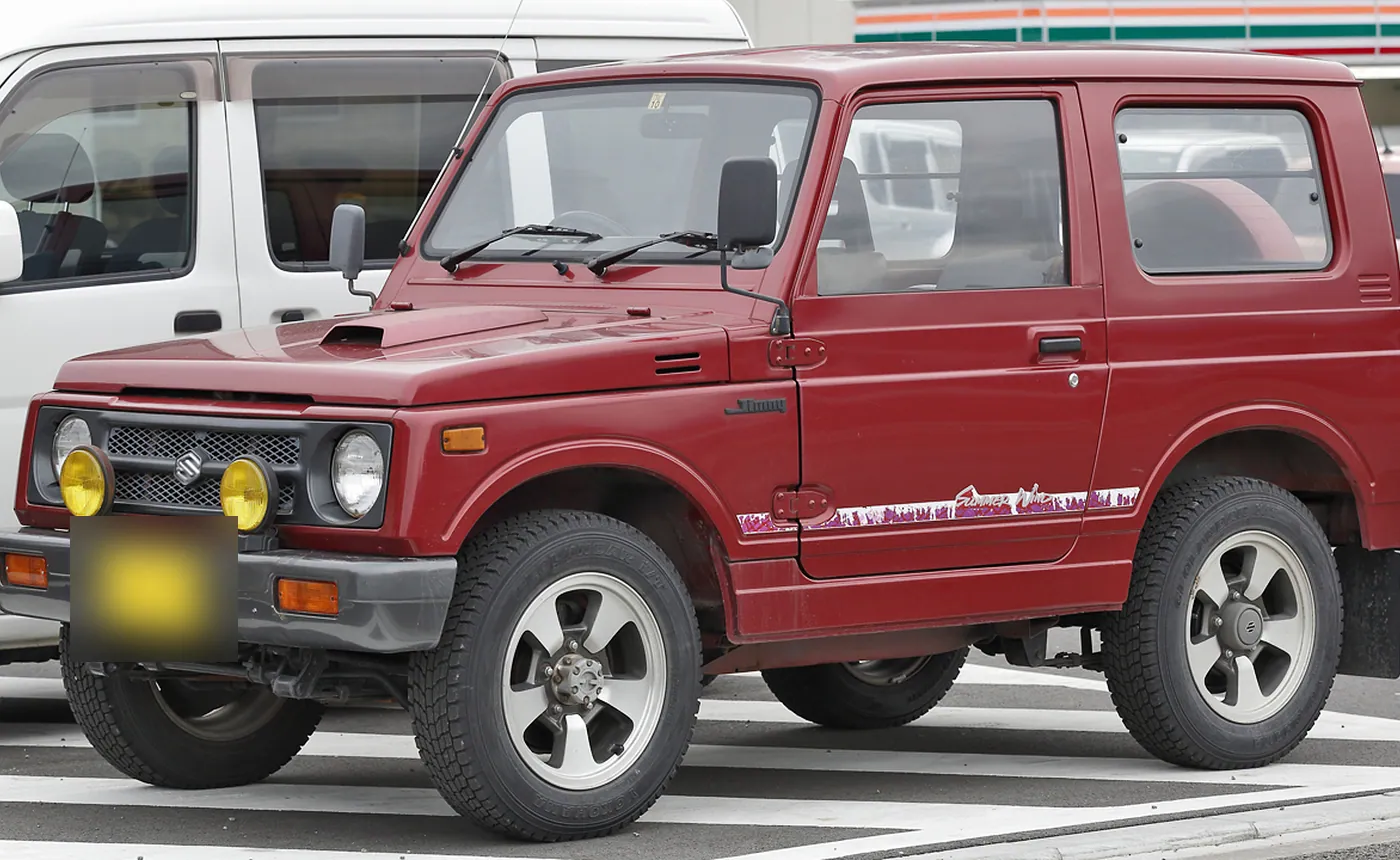
In the mountains of Nagano and the forestry roads of Hokkaido, there are tracks so narrow that a full-size four-by-four has to reverse out the way it came. For half a century, the vehicle that went down them anyway has been the Suzuki Jimny. Foresters, linesmen, hunters and farmers have relied on it because it is small enough to squeeze between trees and tough enough to keep going when the road becomes a stream bed.
The JA11, built from 1990 to 1995, is a high point of that story. It took the second-generation Jimny body that Suzuki had introduced in 1981 and gave it a turbocharged 660 cc engine to suit Japan's newly enlarged kei rules.
The specs
| Years built | 1990–1995 |
|---|---|
| Engine | 657 cc three-cylinder turbo (F6A) |
| Power | 55 PS at launch, later 64 PS |
| Gearbox | 5-speed manual; automatic on some later cars |
| Drive | Part-time four-wheel drive with low range |
| Body styles | Soft top (JA11C) and hardtop van (JA11V) |
| Suspension | Rigid axles on leaf springs front and rear |
Why Suzuki built it
The Jimny began in 1970 as a tiny, two-stroke kei off-roader, built on the idea that real four-wheel drive did not need a big engine or a big body. The second generation, launched in 1981, sold around the world with larger engines under names such as SJ410, SJ413 and Samurai. In Japan, however, the kei versions remained central to the line.
When Japan raised the kei limits in 1990 to 660 cc and a body length of 3,300 mm, Suzuki replaced the 550 cc JA71 with the JA11. The new engine was the F6A three-cylinder turbo, the same family that would power the Cappuccino and the later Alto Works.
Design and engineering
The JA11 is built the old-fashioned way. A separate ladder chassis carries rigid axles front and rear on leaf springs, with a part-time four-wheel-drive system and a low-range transfer box. The driver selects four-wheel drive with a lever, and the front hubs on many models must also be engaged.
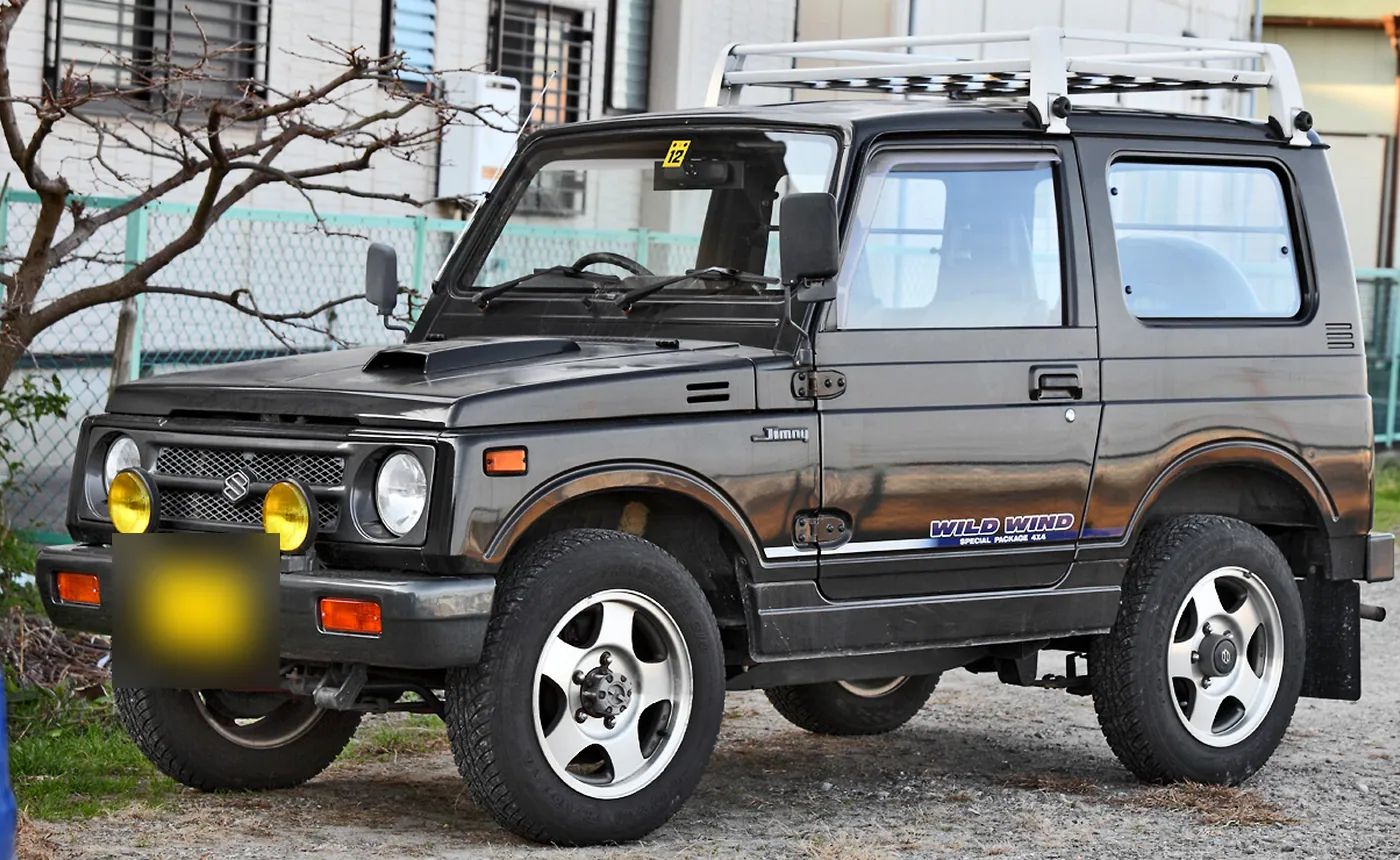
The F6A engine started at 55 PS and was later raised to the 64 PS kei maximum. The result is a vehicle that is slow on tarmac but superbly geared off-road, with short overhangs and a light body that rarely sinks into soft ground. Suzuki offered a canvas-topped JA11C and a steel-roofed JA11V, the latter registered as a commercial van.
How it drives today
On the road, the JA11 is crude. Leaf springs give a firm, bouncy ride, the steering is slow and vague, and the short wheelbase means the vehicle reacts to every ripple. At motorway speeds it is noisy and busy, and a crosswind on an exposed road can push it around.
Off the road it is transformed. In low range, the JA11 crawls over rocks and through mud with a calm, unstoppable gait, and its narrow body lets it pass where larger vehicles cannot. In Ireland it is happiest on bog roads, forestry tracks, beaches where permitted and farm lanes.
The versions worth knowing
The early JA11 with 55 PS is the simplest version. Later cars have more power and some updates to trim and equipment. Soft tops are the most charismatic and the most sought after for summer use, while hardtop vans are more practical in Irish weather. Special editions were offered, and many cars were fitted with aftermarket lift kits, bull bars and larger tyres. The JA12 and JA22 that replaced it in 1995 moved to coil springs, so the JA11 is the last kei Jimny on leaf springs.
What to look for when buying one in Japan
Rust is the critical issue. Check the chassis rails, especially at the rear and around the spring hangers, the body floor, the sills, the door bottoms and the rear crossmember. Jimnys used in snowy regions or near the sea may have heavy corrosion hidden under underseal or mud. Look under the car carefully, and ask for clear photographs if you cannot see it in person.
Many JA11s have been modified, sometimes heavily. Lift kits, larger tyres, aftermarket turbos and exhausts are common, and some cars have been used hard off-road. A mostly standard car is usually the safer buy. Check the steering box, the kingpins, the transfer box and the axles for wear or leaks. Mechanical parts are widely available because of the Jimny's huge following worldwide.
As with any off-roader of this age, the odometer reading should be treated with caution. Judge condition, history and the auction sheet. Make sure the export paperwork matches the chassis number.
Should you import one?
The JA11 suits a buyer who wants a genuine, tiny off-roader for rural use, fun or weekend adventures. It is not comfortable on the motorway and it is basic inside, but it has enormous character and real ability.
In Ireland, it fits perfectly on narrow country roads and farm tracks, and it is right-hand drive. Cars from 1990 to 1995 are now over 30 years old and can qualify for Ireland's vintage treatment. Expect a rugged, simple machine that needs regular rust prevention and will happily go further off-road than most modern SUVs.
Frequently asked questions
What engine does the Suzuki Jimny JA11 have?
A 657 cc F6A turbocharged three-cylinder, rated at 55 PS at launch and later at the 64 PS kei maximum.
Is the JA11 a good off-roader?
Yes. It has a ladder chassis, rigid axles, part-time four-wheel drive and low range, and its small size lets it pass where larger vehicles cannot.
What is the main thing to check on a JA11?
Rust in the chassis, floor, sills and rear crossmember, along with signs of heavy modification or hard off-road use.
More Japanese classics
- Autozam AZ-1: Gullwing Doors, a Mid-Mounted Turbo and Japan's Wildest Kei Car
- Suzuki Cappuccino: A Tiny Front-Engined Roadster With a Very Grown-Up Chassis
- Suzuki Alto Works: The Little Hatch That Set Japan's 64 PS Kei Car Limit
- Suzuki Carry Truck: Six Decades of Japan's Toughest Little Workhorse
- Nissan Figaro: The 1991 Retro Convertible Ireland and the UK Fell in Love With
- All 90 Japanese classics you can import
Photo credits
- Photo: 天然ガス / Wikimedia Commons, CC BY-SA 4.0
- Photo: Tennen-Gas / Wikimedia Commons, CC BY-SA 3.0