
Datsun Bluebird (510): the family saloon that won the Safari Rally and conquered America
The 510 Bluebird was a simple, modern saloon with independent rear suspension and an overhead-cam engine. It won the East African Safari Rally and became a cult car in the United States.
By the Japan to Ireland editors · · 5 min read
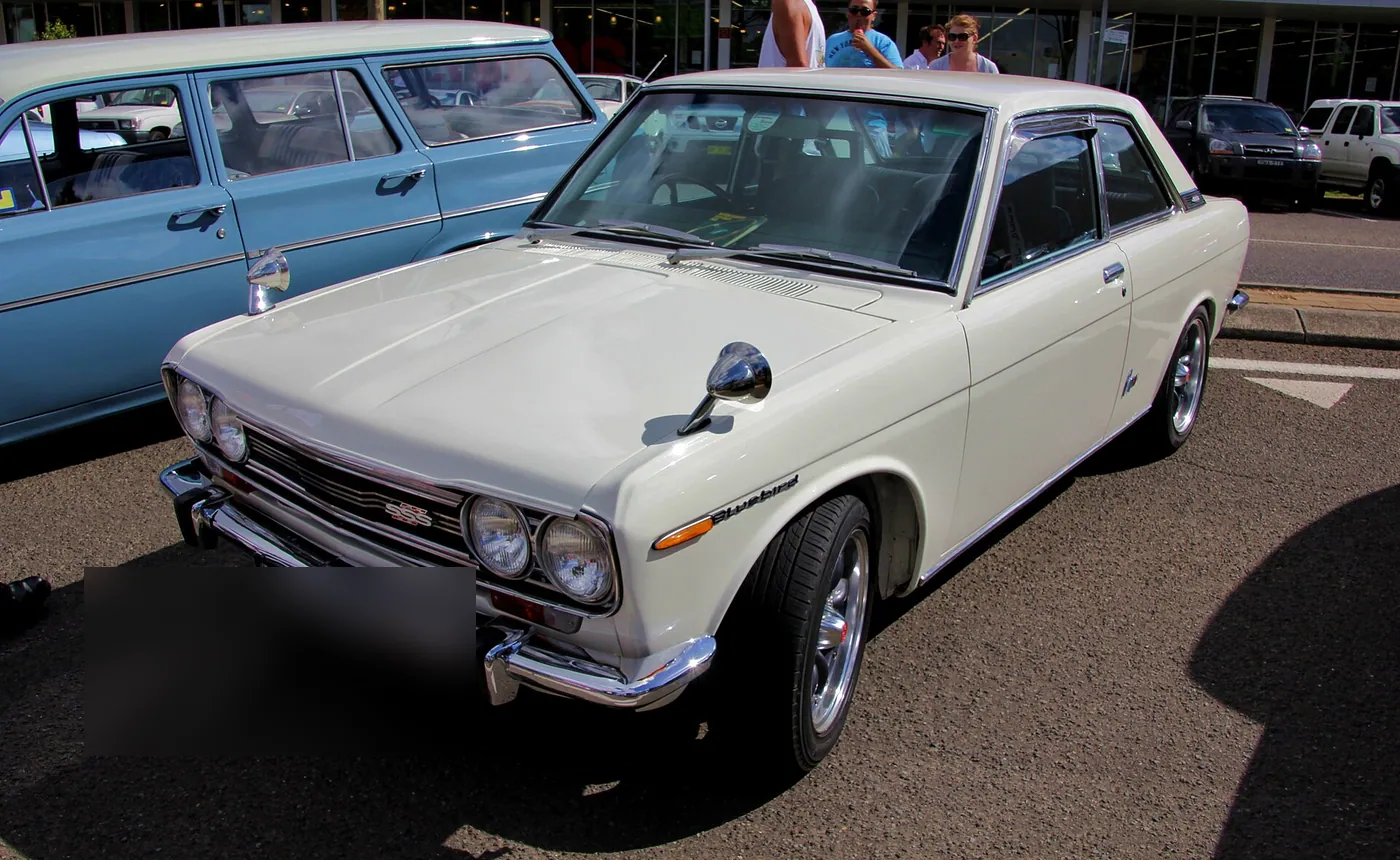
In the spring of 1970, a small Datsun saloon covered in mud crossed the finish line of the East African Safari Rally in first place. The Safari was one of the toughest events in motorsport, thousands of kilometres of rough roads, river crossings and wildlife. The car was a Datsun 1600 SSS, the Bluebird 510, driven by Edgar Herrmann and Hans Schüller. It was a huge moment for Nissan and for the Japanese car industry.
The 510 had been launched in Japan in 1967 as a modern family saloon. It was compact, light and practical, with an overhead-cam engine and independent rear suspension. It became a success in Japan and an even bigger cult car in the United States, where its blend of simplicity and sportiness won many fans.
The specs
| Years built | 1967–1973 |
|---|---|
| Engines | 1.3-litre L13 and 1.6-litre L16 four-cylinder petrol, with twin-carburettor SSS versions |
| Gearbox | 4-speed manual, 3-speed automatic |
| Drive | Rear-wheel drive |
| Body styles | 2-door and 4-door sedan, estate, coupé |
| Suspension | MacPherson strut front, semi-trailing arm independent rear on sedans |
| Famous win | 1970 East African Safari Rally |
Why it was built
In the late 1960s Japan was growing rapidly. The economy was expanding, motorways were being built and more families could afford cars. Nissan wanted a modern saloon to compete with the Toyota Corona and to sell abroad. The 510 was designed to be light, reliable and fun to drive, with technology that was advanced for its class.
In the United States, Nissan's executive Yutaka Katayama championed the car. It became known for its value and its performance in racing, especially in the Trans-Am 2.5 Challenge, where Brock Racing Enterprises cars won championships in 1971 and 1972.
Design and engineering
The 510 has a clean, boxy body with crisp lines. Saloons use MacPherson struts at the front and a semi-trailing arm independent rear suspension, a feature more common on expensive European cars at the time. The estate used a simpler solid rear axle with leaf springs.
Engines were Nissan's L-series overhead-cam four-cylinders, mainly the 1.3-litre L13 and 1.6-litre L16. The SSS versions used twin carburettors for more power. Gearboxes included a four-speed manual and a three-speed automatic.
Body styles included two-door and four-door saloons, an estate and a coupé.
How it drives today
The 510 is light, nimble and responsive. The steering is direct, the independent rear suspension gives good grip and comfort, and the L16 engine is lively and willing. It feels small and agile, with good visibility.
On Irish roads the 510 is a delightful classic for country drives. It keeps up with modern traffic on main roads, though it lacks modern safety features. The brakes require more effort than modern cars.
The best way to understand the car is to drive it on a road like the old coast routes of Clare or Donegal, where the surface rises and falls and the bends tighten without warning. The independent rear suspension keeps the car settled over bumps that would unsettle a cart-sprung saloon of the same period, and the light body means it changes direction eagerly. The L16 engine likes to rev and sounds better the harder it works. It is not fast by modern standards, but it is involving in a way many modern cars are not.
Comfort is reasonable for a car of its age. The seats are thin and the cabin is noisy at speed, but the driving position is upright and the view out is excellent, with slim pillars and a low scuttle. Heating and ventilation are basic, and owners who use their cars in Irish winters often find the demisting slow.
The versions worth knowing
The SSS models are the most sought after for their twin-carburettor engines and sportier trim. The two-door saloon is the classic choice for enthusiasts. The coupé is rarer. Estates are practical but less sporting.
Export cars were badged as the Datsun 1300, 1600 and so on, while Japanese-market cars carried the Bluebird name. A Japanese car is the natural choice for an Irish buyer because it is right-hand drive from the factory, and Japanese-market trim details, badges and equipment are part of what collectors look for.
What to check when buying one in Japan
Rust is the main concern. Check the sills, floor pans, wheel arches, boot floor, suspension mounts and the bottom of the doors. Many cars have been restored, so look carefully at the quality of the work.
Many 510s have been modified with engine swaps, uprated suspension and aftermarket wheels. Original cars are rarer and more valuable. Parts for the L-series engine are widely available, but body panels and trim are scarce.
Odometer readings are uncertain at this age, so look for records and evidence of maintenance. Ensure the export certificate and paperwork are complete.
Mechanically, the L-series engine is robust and well understood. Check for smoke, low oil pressure and worn timing chains, and make sure twin-carburettor SSS engines are balanced and running cleanly. The rear suspension on saloons uses rubber bushes that will often need replacing, and the differential mountings should be checked. Many owners upgrade the brakes, which is a sensible change, but keep the original parts if they come with the car.
Should you import one?
The 510 suits someone who wants a light, fun and historically significant classic. It is right-hand drive in Japanese form, ideal for Irish roads. It is simple to work on and has a strong international following.
Cars over 30 years old can qualify for Ireland's vintage treatment, and every 510 is well past that age. Find a car with a solid body and honest history. A good 510 is a charming and rewarding classic that tells an important story about the rise of Japan's car industry.
Frequently asked questions
Did the Datsun 510 win the Safari Rally?
Yes. A Datsun 1600 SSS driven by Edgar Herrmann and Hans Schüller won the 1970 East African Safari Rally.
Why is the 510 so popular in the United States?
It offered good performance, reliability and value, and it was successful in Trans-Am racing in the early 1970s.
Which version is most desirable?
The SSS versions with twin carburettors, especially the two-door saloon, are the most sought after.
Is rust a big problem?
Yes. Check the sills, floors, arches, boot floor and suspension mounts carefully, and inspect any restoration work.
More Japanese classics
- Nissan Safari (Y60): the coil-sprung Patrol built for the hardest roads on earth
- Nissan Cima (Y31): the turbo luxury saloon that gave its name to a boom
- Nissan March Super Turbo: a twincharged Micra built for Japan's hot hatch wars
- Nissan Rasheen: the boxy little four-wheel drive Japan kept to itself
- Mitsubishi Pajero (first generation): the square-rigged 4x4 that conquered the desert
- All 90 Japanese classics you can import
Photo credits
- Photo: sv1ambo / Wikimedia Commons, CC BY 2.0