
Nissan March Super Turbo: a twincharged Micra built for Japan's hot hatch wars
Nissan fitted its tiny March with both a supercharger and a turbocharger, creating one of the most unusual and entertaining small cars of the bubble era.
By the Japan to Ireland editors · · 4 min read
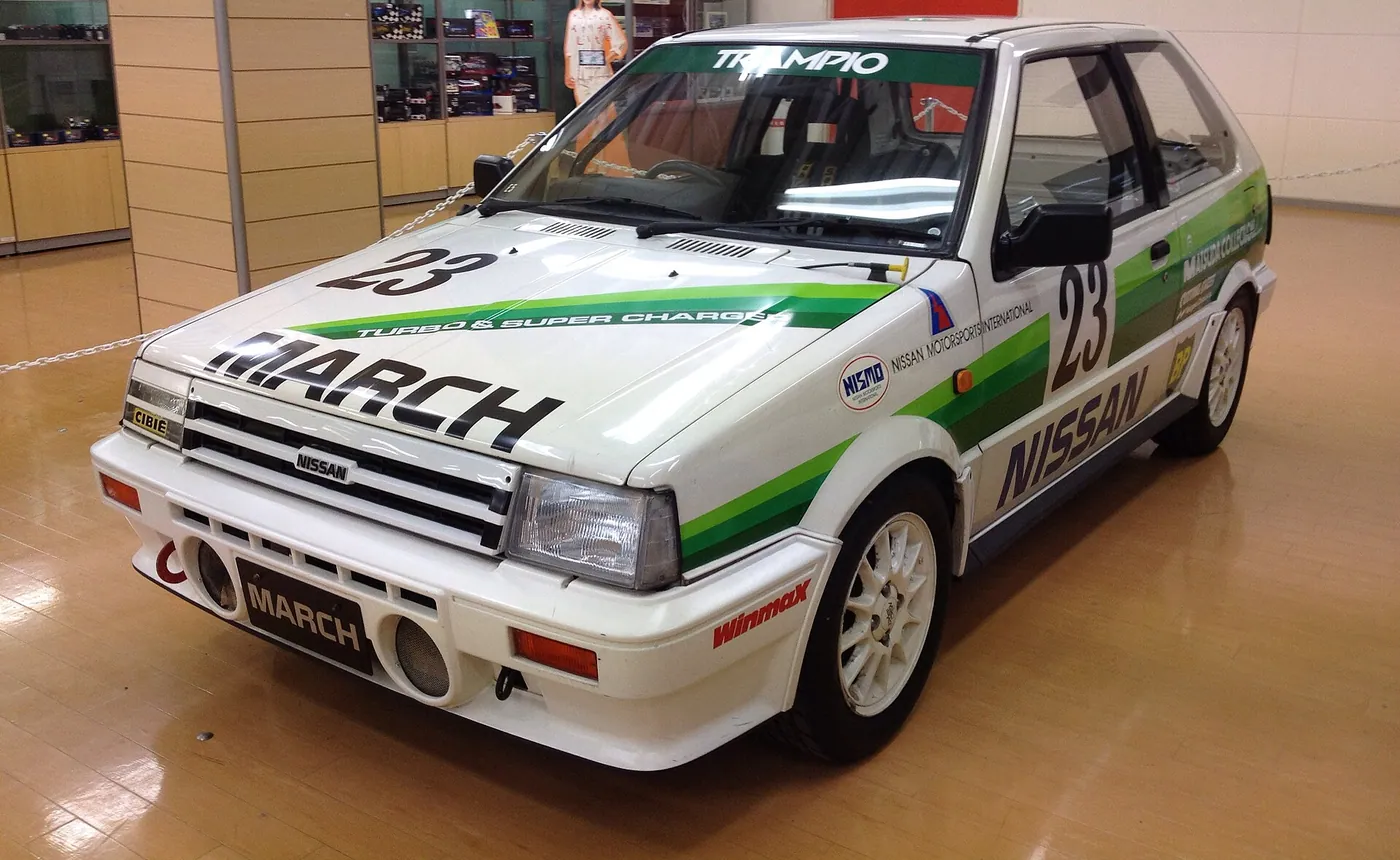
At the end of the 1980s, Japan's small cars were getting faster. Manufacturers fitted turbochargers to tiny hatchbacks, and the market was full of pocket rockets. Nissan's entry was one of the most technically ambitious: the March Super Turbo, launched in 1989, which used both a supercharger and a turbocharger on a tiny engine.
The March was the car sold in Ireland as the Micra, a simple and practical small hatchback. The Super Turbo turned it into something far more lively. It remains one of the strangest and most engaging small cars of its era.
The specs
| Years built | 1989–1991 |
|---|---|
| Engine | 930cc MA09ERT four-cylinder with supercharger and turbocharger |
| Power | 110 PS |
| Gearbox | 5-speed manual or 3-speed automatic |
| Drive | Front-wheel drive |
| Body styles | 3-door hatchback |
| Base | Nissan March (K10) |
Why it was built
Nissan had already built the March R, a rally-focused model with a twincharged engine, intended for motorsport. The engine's capacity was reduced to just under one litre so the car would fit into a lower class once the turbo was taken into account under competition rules. The Super Turbo was the road-going version for the public.
Japan in 1989 was at the peak of the bubble economy. Buyers had money and wanted exciting cars, even in the small car class. The Super Turbo was part of that enthusiasm.
Design and engineering
The engine is the 930cc MA09ERT, a four-cylinder with a supercharger for low-speed response and a turbocharger for higher speeds. It produces around 110 PS, a remarkable figure for its size. The car weighs well under a tonne, giving it strong performance.
The Super Turbo used the three-door March body with modest styling changes, and to most passers-by it looked like a slightly sportier version of an ordinary small hatchback. That understatement is part of its charm. Gearboxes included a five-speed manual and a three-speed automatic.
The twincharging idea is clever. A small turbocharger needs exhaust flow to spin up, so on its own it leaves a small engine feeling flat at low revs. A supercharger, driven by the engine, gives boost almost immediately but becomes less efficient higher up. By combining them, Nissan tried to give a tiny engine the response of a larger one at low speed and the punch of a turbo at high speed. Lancia had used a similar approach in rallying with the Delta S4, but a twincharged engine in an everyday Japanese small car was a remarkable thing.
How it drives today
The Super Turbo is quick, lively and fun. The twincharged engine gives strong low-speed response and a surge of power at higher revs. The car is light and agile, with direct steering. It can be a handful in the wet, as the front wheels struggle to put the power down.
On Irish roads the Super Turbo is enjoyable on twisting back roads and in town. On motorways it is noisy and busy but can keep up with traffic.
It helps to remember what the car is underneath. The chassis, brakes and suspension come from a small economy hatchback designed in the early 1980s. They were improved for the Super Turbo, but they are not the equal of a modern hot hatch. The car rewards smooth driving: brake in a straight line, be gentle with the throttle out of a wet bend and let the engine do its work on the straights. Driven that way, it is a lot of fun at sensible speeds, which is exactly what you want on an Irish back road.
Practicality is that of a first-generation Micra. There is room for four adults on short trips, a small boot and a simple, durable cabin. Visibility is excellent and the car is easy to park, which makes it a realistic choice for city owners.
The versions worth knowing
The manual Super Turbo is the enthusiast's choice. The automatic is less sporting but still quick for its size. The March R, the earlier competition-focused model with the same twincharged engine concept, is much rarer and was intended for owners who planned to compete.
What to check when buying one in Japan
Check the engine carefully. The twincharged system is complex, and the supercharger, turbocharger and associated components can wear. Look for oil leaks, smoke and boost problems. The cooling system should be in good condition.
Rust appears in the sills, wheel arches, floor and tailgate. Many cars have been modified or driven hard, so look for accident damage and signs of hard use. Original parts, especially for the engine, are scarce.
Odometer readings can be uncertain, so look for records and a sensible auction history. Ensure the export certificate and paperwork are complete.
Be wary of cars where the boost has been turned up or the supercharger has been removed. Some owners have simplified the system over the years, and while that can make a car easier to maintain, it removes the very thing that makes the Super Turbo special. Ask for underbonnet photographs and compare them with factory images. Check that the supercharger clutch engages properly and that the engine pulls cleanly from low revs.
Should you import one?
The March Super Turbo suits someone who wants a rare, quirky and entertaining small car. It is right-hand drive, compact and fun on Irish roads. It requires careful maintenance and parts can be difficult to source.
Cars over 30 years old can qualify for Ireland's vintage treatment, and the March Super Turbo has reached that age. Find an original, well-maintained car with good records. A good Super Turbo is a unique and enjoyable classic that few people in Ireland will recognise.
Frequently asked questions
What is a twincharged engine?
It is an engine that uses both a supercharger and a turbocharger to boost power across the rev range.
How powerful is the March Super Turbo?
Its 930cc engine produces around 110 PS, which is a lot for such a small and light car.
Is it the same as a Micra?
It is based on the first-generation March, sold in Ireland as the Micra, but with a much more powerful engine.
Are parts difficult to find?
Some general parts are shared with the standard March, but engine-specific and trim parts are scarce.
More Japanese classics
- Datsun Bluebird (510): the family saloon that won the Safari Rally and conquered America
- Nissan Safari (Y60): the coil-sprung Patrol built for the hardest roads on earth
- Nissan Rasheen: the boxy little four-wheel drive Japan kept to itself
- Mitsubishi Pajero (first generation): the square-rigged 4x4 that conquered the desert
- Mitsubishi Pajero (second generation): the Dakar king that became Japan's family 4x4
- All 90 Japanese classics you can import
Photo credits
- Photo: Iwao from Tokyo, Japan / Wikimedia Commons, CC BY-SA 2.0