
Eunos Roadster (NA): the little car that brought the sports car back from the dead
When the classic British roadster had all but vanished, Mazda built a lighter, more reliable version and changed the industry. The Japanese-market NA is still one of the best classic cars to import.
By the Japan to Ireland editors · · 4 min read
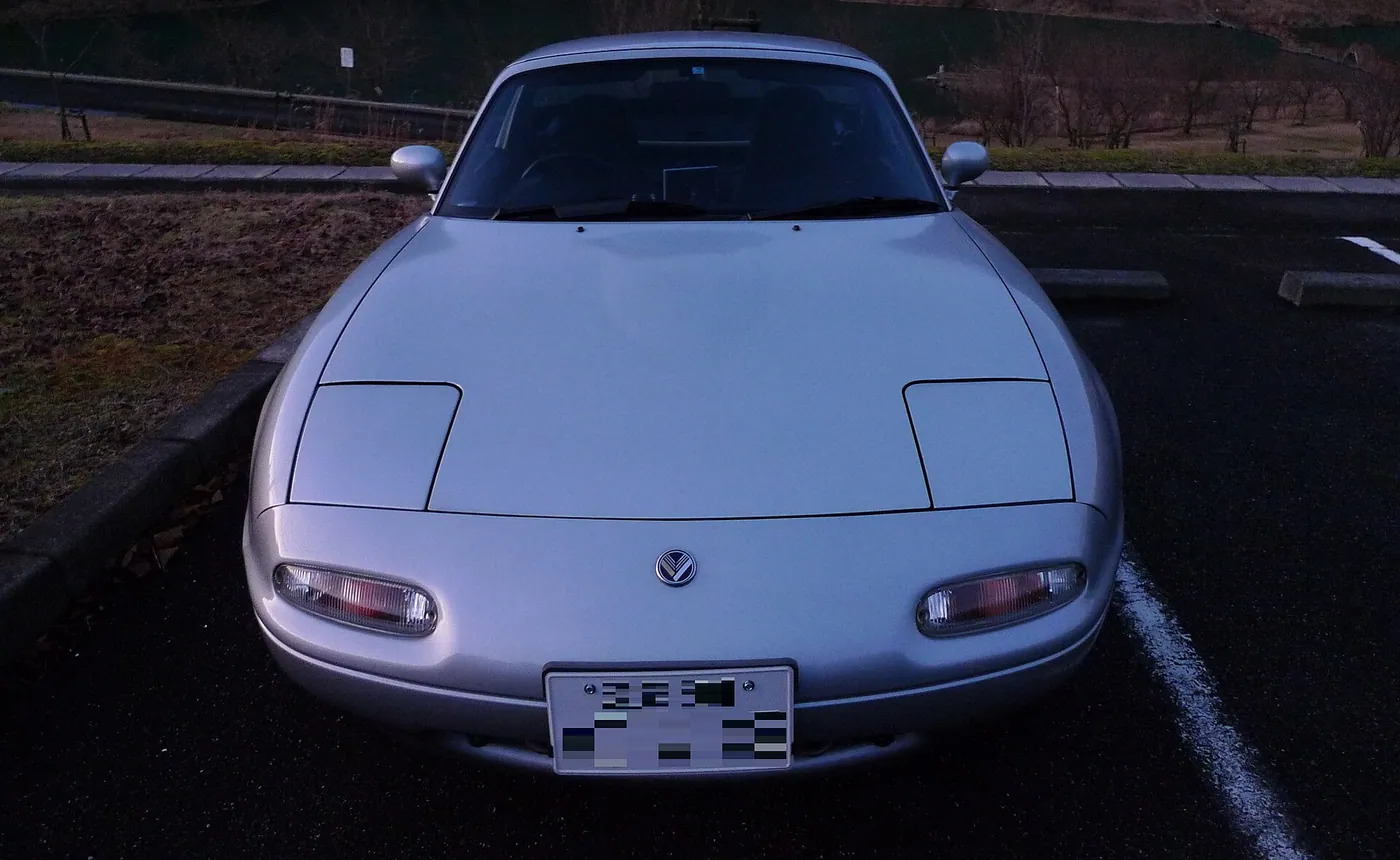
In February 1989, at the Chicago Auto Show, Mazda unveiled a small, rounded two-seat roadster with pop-up headlamps and a smiling grille. It was called the MX-5 Miata. A few months later, in September, it went on sale in Japan as the Eunos Roadster. Within a short time, it had changed the direction of the sports car market around the world.
The NA, as the first generation is known, is often credited with reviving the affordable sports car. The classic British roadsters of the 1960s had largely disappeared, and few manufacturers believed there was money in building cheap, light, open two-seaters. Mazda proved them wrong.
The specs
| Years built | 1989–1997 |
|---|---|
| Engine | 1.6-litre (B6-ZE) or 1.8-litre (BP-ZE) DOHC inline-four |
| Power | 120 PS (1.6), 130 PS (1.8) |
| Gearbox | 5-speed manual, 4-speed automatic |
| Drive | Rear-wheel drive |
| Body styles | Two-seat roadster, optional hardtop |
| Kerb weight | About 940 kg (1.6) |
| Japanese launch | September 1989 |
Why Mazda built it
The idea grew from enthusiasts inside Mazda, including Bob Hall in the company's California studio, who argued for a modern version of the classic small roadster. The project was led in Japan by chief engineer Toshihiko Hirai, who championed the idea of jinba ittai, the sense of horse and rider as one. The Lotus Elan of the 1960s was a clear influence.
Japan in the late 1980s was at the peak of the bubble economy, and Mazda had the confidence and resources to try something unusual. The Eunos brand gave the Roadster a distinctive home in Japanese showrooms.
Design and engineering
The NA is a simple car in the best sense. The 1.6-litre twin-cam engine, the B6-ZE, produced 120 PS and drove the rear wheels through a slick five-speed manual gearbox. From 1993 the 1.8-litre BP-ZE replaced it, with 130 PS and a stiffer body.
Suspension is by double wishbones at all four corners. A rigid aluminium structure called the Power Plant Frame links the gearbox to the differential, sharpening throttle response. The car weighs around 940 kg in early form, and weight distribution is close to even.
The design is clean and timeless, with pop-up headlamps, smooth surfaces and a simple, driver-focused cabin. The soft top can be raised or lowered by hand in seconds. Many Japanese cars also come with the factory hardtop, which is worth having in an Irish winter, since it makes the cabin quieter, warmer and far more secure. Early soft tops have a plastic rear window that clouds and cracks with age, while later replacements often use glass.
How it drives today
The NA is pure joy on a good road. The steering is quick and communicative, the gearshift is short and precise, and the car responds instantly to the smallest input. It is not fast by modern standards, but it feels lively because you are so connected to it.
On Irish roads, from boreens to winding coastal routes, it is an ideal companion. It is reliable enough to use regularly, and it copes well with motorway driving, though it is noisy and the hood offers limited insulation. In wet weather it remains manageable, with balanced handling and predictable behaviour.
Versions worth knowing
Japan received many special editions. The V-Special, with green paint and tan leather, is one of the most recognisable. The J-Limited of 1991, in bright yellow, was a limited run. The S-Special added sportier suspension. The M2 editions, built by Mazda's M2 division, are rare and collectable. The 1.8-litre cars from 1993 are slightly quicker and stiffer.
What to check when buying in Japan
Rust is the main enemy. Check the sills, particularly ahead of the rear wheels, and the rear wheel arches. Blocked drains behind the seats allow water to collect and rot the body from inside. Inspect the floor and front chassis areas as well.
Early 1.6-litre cars can suffer from a crankshaft problem known as the short-nose crank, where the front of the crankshaft is damaged by a loose pulley. Check for wobble at the crank pulley and listen for unusual noises. Look for oil leaks, worn soft tops and tired suspension. Test the pop-up headlamps several times, since the motors and their linkages wear.
Many NAs have been modified with lowered suspension, aftermarket wheels and exhausts, or turbochargers. Decide whether you want an original car or a modified one. Mileage can be difficult to prove on older cars, so service records and condition matter more.
Parts are easier to find than for most classics. Mazda has reissued many original NA parts through its restoration programme in Japan, and aftermarket support is huge. Check chassis numbers against the documents and confirm the Japanese export certificate is in order.
Should you import one?
The NA suits almost anyone who wants a classic sports car that is reliable, affordable to run and enormous fun. It is one of the most practical ways into classic car ownership, and it is a genuine pleasure on Irish roads.
Many NAs are now over 30 years old and can qualify for Ireland's vintage treatment. Keep the drains clear, treat rust early and use it regularly. Few cars of any era offer so much enjoyment for so little drama.
Frequently asked questions
What is the difference between the Eunos Roadster and the MX-5?
They are the same car; Eunos Roadster was the Japanese-market name, while MX-5 and Miata were used elsewhere.
Which engine is better, the 1.6 or 1.8?
The 1.8-litre from 1993 has slightly more power and a stiffer body, while the 1.6-litre is lighter and revs more freely.
What is the short-nose crank problem?
Early 1.6-litre cars can suffer damage to the front of the crankshaft caused by a loose pulley, so check for wobble before buying.
Are parts easy to find?
Yes, Mazda has reissued many original NA parts in Japan and aftermarket support is very strong.
More Japanese classics
- Eunos Cosmo: the three-rotor bubble-era coupe that showed Japan the future
- Mazda RX-7 (FD3S): the most beautiful rotary, and the most demanding to own
- Toyota Supra (A70): the turbocharged GT that gave the Supra its own name
- Toyota Supra (A80): The Grand Tourer That Became a Legend by Accident
- Toyota AE86 Levin and Trueno: The Humble Corolla That Taught the World to Drift
- All 90 Japanese classics you can import
Photo credits
- Photo: Motokoka / Wikimedia Commons, CC BY-SA 4.0