
Isuzu Bighorn: The Square-Shouldered Off-Roader Ireland Already Knows as the Trooper
Built on a ladder frame and offered with durable diesel engines, the first Bighorn was a working four-by-four that grew into a family car. Japanese examples include tuned versions never sold here.
By the Japan to Ireland editors · · 4 min read
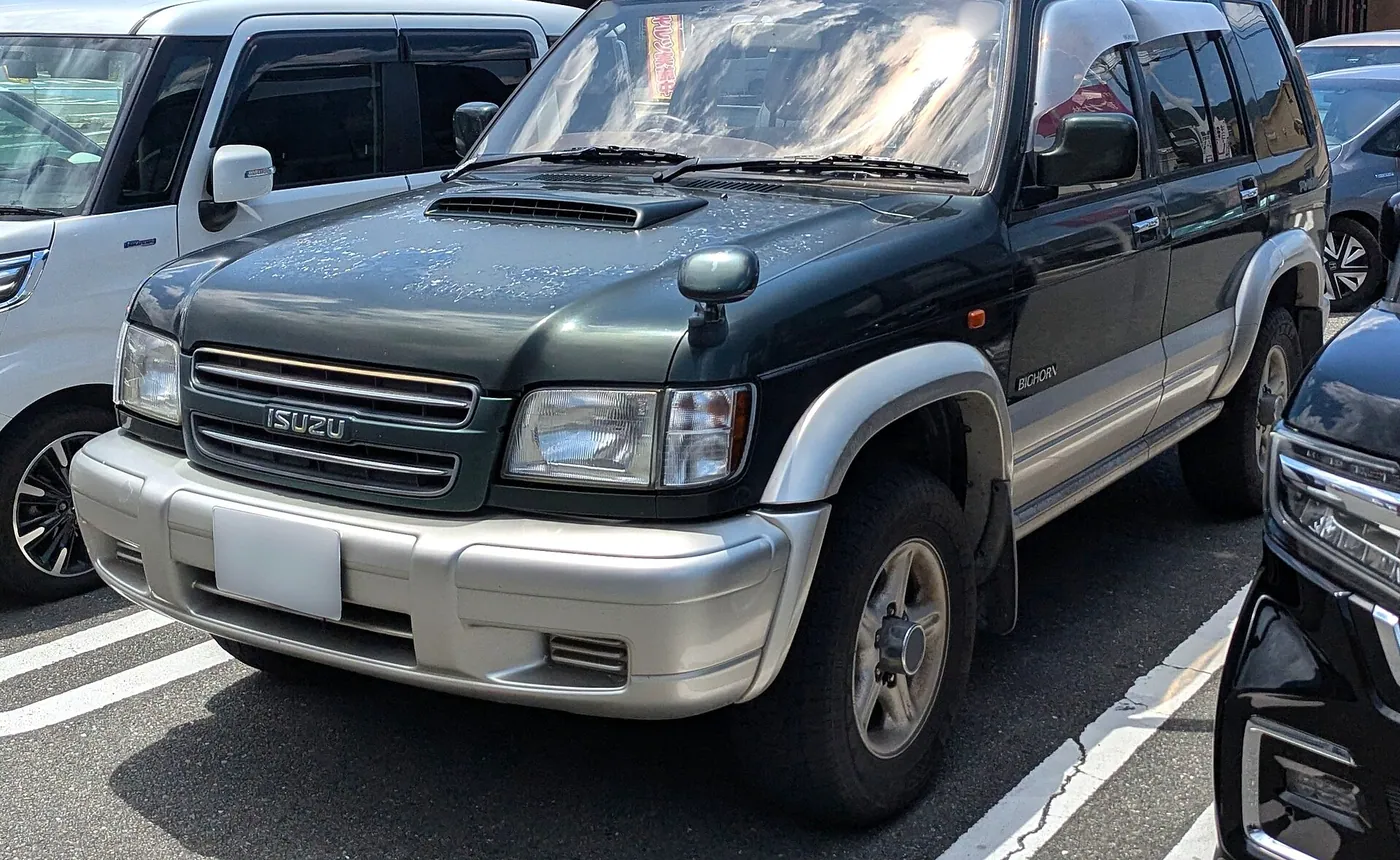
On farms across Ireland in the 1980s and 1990s, the Isuzu Trooper was a familiar shape: a tall, square box on big tyres, usually with a tow bar and a trailer behind it. In Japan the same vehicle was called the Bighorn. It first appeared in 1981, initially under the name Rodeo Bighorn, and the first generation stayed in production until 1991.
Japan at the start of the 1980s was well into its era of export success, and four-wheel-drive vehicles were beginning to shift from purely working machines to leisure vehicles. Skiing, camping and fishing trips into the mountains were becoming weekend pastimes for city families, and carmakers responded with off-roaders that could double as family transport. The Bighorn was Isuzu's answer.
The specs
| Years built | 1981–1991 (first generation) |
|---|---|
| Engine | Four-cylinder diesels including 2.2 and 2.8-litre turbo; four-cylinder petrol in some markets |
| Power | Modest by modern standards |
| Gearbox | 5-speed manual or automatic |
| Drive | Part-time four-wheel drive with low range |
| Body styles | 3-door short wheelbase, 5-door long wheelbase |
| Known in Ireland as | Isuzu Trooper |
Why Isuzu built it
Isuzu had long experience with trucks and pickups. A tough, body-on-frame four-wheel drive was a natural extension of what it already did well. The Bighorn shared engineering thinking with Isuzu's pickups and gave the company a product that could be sold around the world, both under its own name and through General Motors partners. In Australia it became the Holden Jackaroo, and in Europe it was sold as the Trooper.
Design and engineering
The first Bighorn was built on a separate ladder chassis with independent front suspension using torsion bars and a live rear axle on leaf springs. Four-wheel drive was part-time, with a low-range transfer case for proper off-road work. The design was simple and strong, chosen for durability rather than sophistication.
The body was resolutely square, with flat glass, upright pillars and a large rear door. The short-wheelbase three-door was compact and agile off road; the long-wheelbase five-door had real space for passengers and luggage. Diesel engines were central to the range, including a 2.2-litre diesel and later a 2.8-litre turbocharged diesel that gave the vehicle a much better turn of speed. Petrol engines were offered in some markets.
How it drives today
A first-generation Bighorn feels like the working vehicle it was designed to be. The steering is slow, the ride is firm and bouncy when unladen, and the diesels are noisy and unhurried. Cruising at motorway speed is possible with the turbo diesel, but it is not where the vehicle is happiest.
Off the road it is a different story. With low range engaged and decent tyres, it will climb muddy lanes, cross wet fields and tow a horsebox with ease. For Irish farm and rural use, that capability is the point. The view from the high seat is excellent, and the square body makes it easy to place on narrow roads.
Versions worth knowing
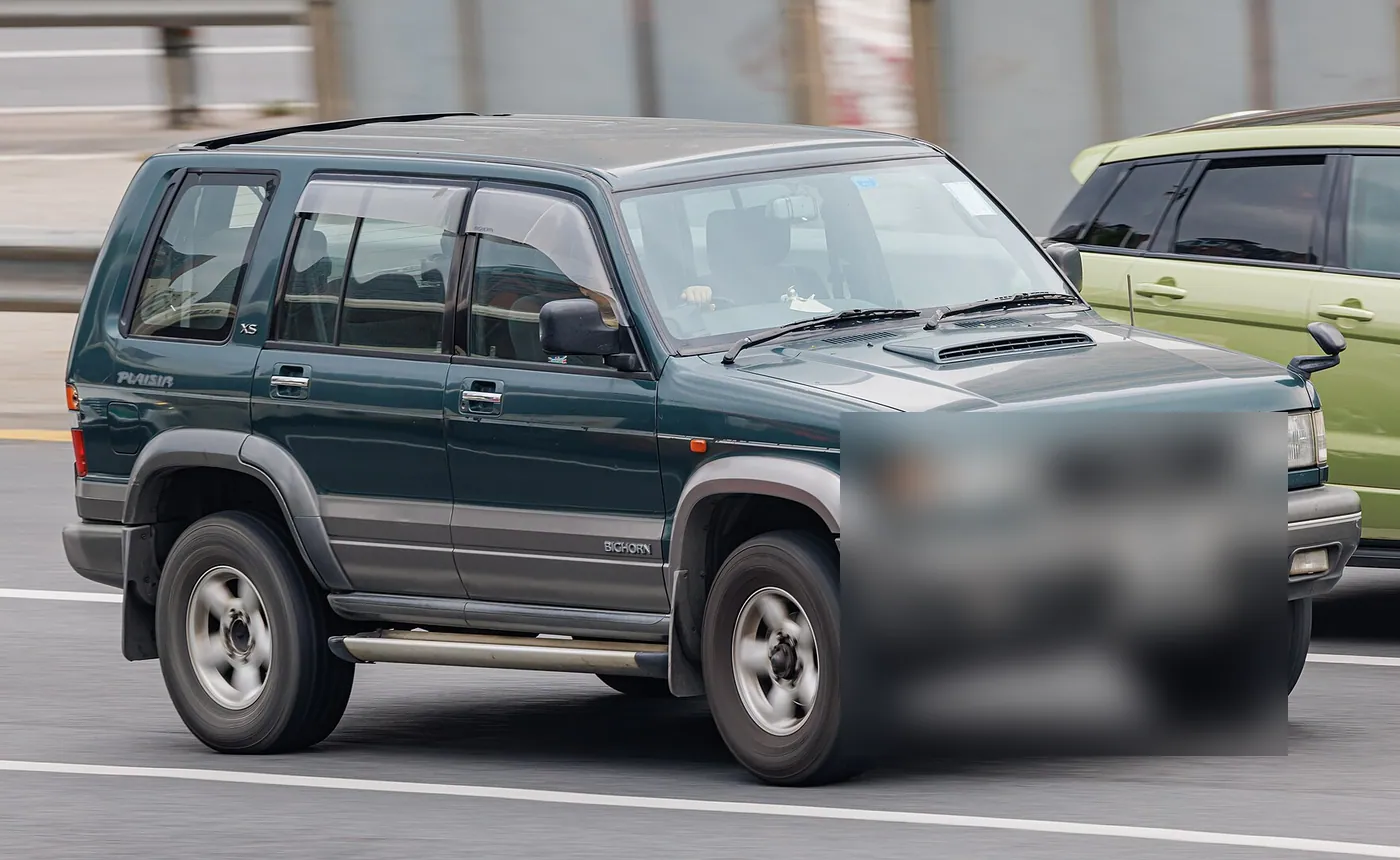
Japan received versions that were never offered in Ireland. The Irmscher edition added German-tuned suspension and styling details. Later in the first generation's life, Isuzu offered a Bighorn with suspension tuned by Lotus, sold under the Handling by Lotus name, which reflected the links between Isuzu, General Motors and Lotus at the time. These are the most interesting for collectors.
Otherwise, the choice is between short and long wheelbase, and between the earlier non-turbo diesel and the more usable turbo diesel. The long-wheelbase turbo diesel is the most practical for family and towing use.
What to check when buying in Japan
The chassis is the first priority. Inspect the ladder frame for rust, especially around the rear spring hangers, the crossmembers and the areas where mud collects. Check the floors, the sills, the rear door bottom and the wheel arches. Many Bighorns lived in snowy regions where roads are salted, and those cars can be much worse underneath than they look from above.
Mechanically, listen for knocking from the diesel, check for blue or black smoke, and look for oil leaks from the turbo and the transfer case. Engage four-wheel drive and low range to confirm they work. Free-wheeling hubs, where fitted, should lock and unlock properly.
Modified examples with lift kits and oversized tyres are common; decide whether you want that or a standard vehicle. Mileage on old diesels is often uncertain, so look for records and judge on condition. Make sure the export certificate matches the chassis number.
Should you import one?
A first-generation Bighorn suits a buyer who wants a simple, tough classic four-by-four with real off-road ability, and who appreciates the link to the Troopers that once filled Irish farmyards. It is a working classic, best used for towing, farm work, beach access and weekend adventures.
Every first-generation Bighorn is over 30 years old, and cars over 30 years old can qualify for Ireland's vintage treatment. Expect diesel noise, modest performance and some hunting for parts, but also a vehicle built to keep going.
Frequently asked questions
Is the Isuzu Bighorn the same as the Trooper?
Yes. The Bighorn was the Japanese-market name for the vehicle sold in Ireland and the UK as the Isuzu Trooper.
Which Bighorn engine is best?
For most buyers the 2.8-litre turbo diesel, which gives much more usable performance than the earlier non-turbo diesel.
What should I check first?
The ladder chassis, particularly around the rear spring hangers and crossmembers, for rust.
Were there special versions?
Yes. Japan had Irmscher and Handling by Lotus versions with tuned suspension.
More Japanese classics
- Isuzu Piazza: The Giugiaro Concept Car That Made It to the Showroom Almost Unchanged
- Isuzu 117 Coupe: Giugiaro's Early Masterpiece and Japan's Most Elegant 1970s Coupe
- Mazda Familia GT-R: The Turbocharged Rally Hatchback That Arrived Just as the Stage Went Quiet
- Daihatsu Charade GTti: The One-Litre Turbo Hatchback That Out-Engineered Bigger Rivals
- Daihatsu Rocky (F300): The Small, Tough Open-Top Off-Roader Europe Knew as the Feroza
- All 90 Japanese classics you can import
Photo credits
- Photo: Kalmarle / Wikimedia Commons, CC BY-SA 4.0
- Photo: Dinkun Chen / Wikimedia Commons, CC BY-SA 4.0