
Mazda Cosmo Sport 110S: the space-age coupe that proved the rotary engine
Mazda bet its future on an engine everyone else had given up on, and the Cosmo Sport was the proof that it worked. Fewer than 1,200 were built, and each one is a landmark.
By the Japan to Ireland editors · · 4 min read
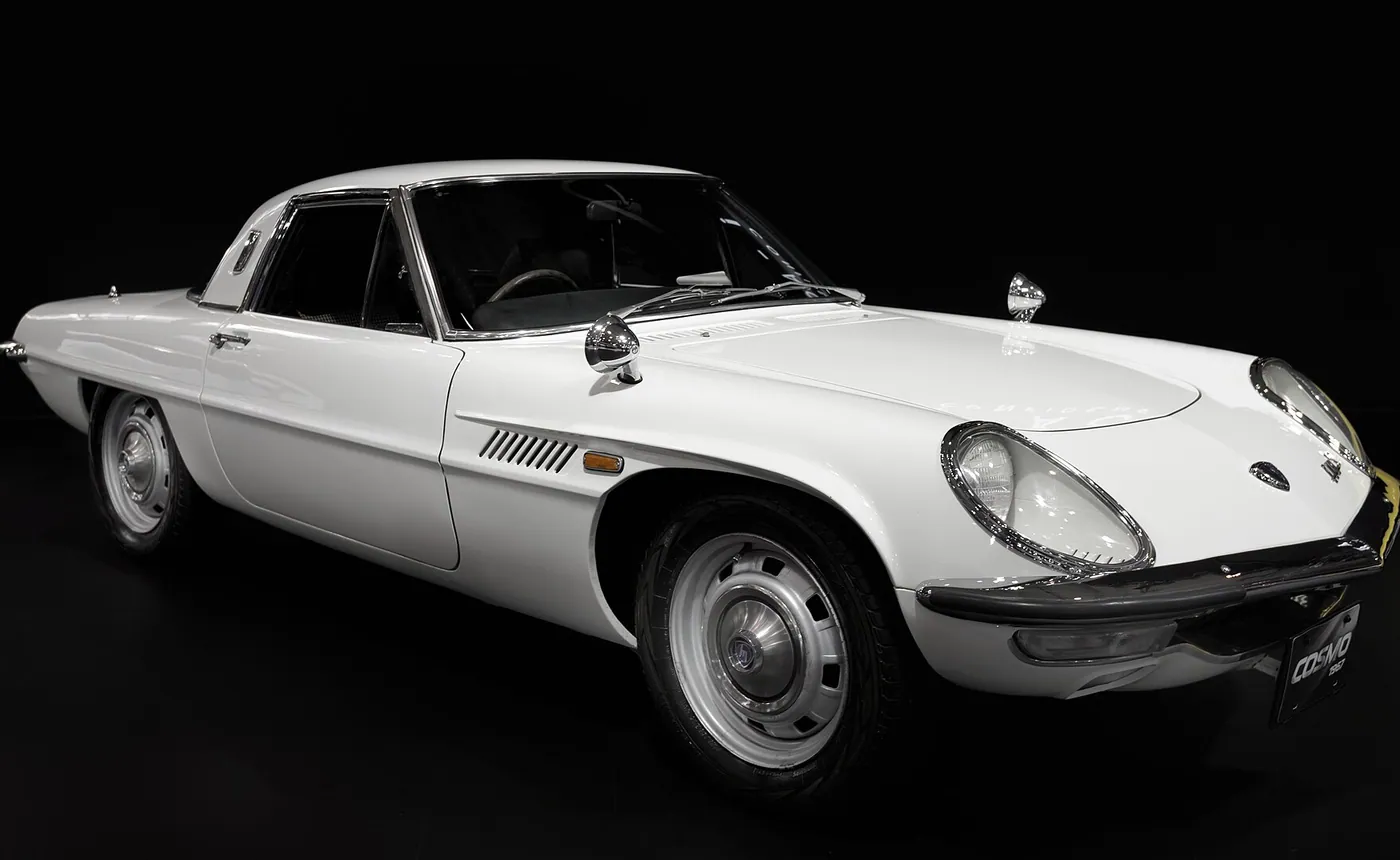
In 1961, Toyo Kogyo, the Hiroshima company that would become Mazda, signed a licence with the German firm NSU to develop Felix Wankel's rotary engine. The engine was compact, smooth and powerful for its size. It also had a serious flaw. Within a short time the inside of the rotor housing would wear grooves, known in Japan as the devil's claw marks, and the engine would lose its seal and its power.
Mazda's engineers, led by Kenichi Yamamoto, spent years solving that problem. The answer came in new apex seal materials and careful engineering, and in May 1967 Mazda launched the Cosmo Sport 110S, the world's first production car with a twin-rotor engine. It looked like nothing else on Japanese roads, and it signalled that Mazda intended to survive as an independent carmaker by doing something no one else could.
The specs
| Years built | 1967–1972 |
|---|---|
| Engine | 982 cc twin-rotor Wankel (10A, L10A and L10B) |
| Power | 110 PS (Series I), 128 PS (Series II) |
| Gearbox | 4-speed manual (Series I), 5-speed manual (Series II) |
| Drive | Rear-wheel drive |
| Body styles | Two-seat coupe |
| Rear suspension | De Dion axle on leaf springs |
| Production | 1,176 (343 Series I, 833 Series II) |
Why Mazda built it
Japan in the 1960s was an industry in consolidation. The government was keen to see fewer, larger car companies, and small firms like Toyo Kogyo faced pressure to merge. The rotary engine offered a way to stand out. If Mazda could make it work, it would have a technology that set it apart from Toyota and Nissan.
Hiroshima itself was a city rebuilding after the atomic bomb of 1945, and Toyo Kogyo was one of its largest employers. The Cosmo was a statement of ambition for the company and the region, a futuristic car designed to show the world that a small Japanese manufacturer could lead in engineering.
Design and engineering
The Cosmo Sport is low, long and dramatic, with a sharply pointed nose, a wraparound rear screen and small tail fins. The compact rotary engine allowed a very low bonnet line, and the whole car has a space-age look that matched the optimism of the era.
The 10A engine has two rotors of 491 cc each, giving 982 cc. In Series I form it produced 110 PS and drove the rear wheels through a four-speed manual gearbox. Front suspension is by double wishbones and coil springs, with a De Dion rear axle on leaf springs and front disc brakes.
The Series II, launched in 1968, brought the L10B engine with 128 PS, a five-speed gearbox, a wheelbase 150 mm longer and improved brakes and cooling. It was faster and more comfortable. In 1968 Mazda also sent two Cosmos to the 84-hour Marathon de la Route at the Nürburgring, where one finished fourth, an important early demonstration of rotary durability.
How it drives today
The rotary engine is the defining sensation. It is smooth and eager, with very little vibration, and it pulls cleanly up to high revs with a buzzing, distinctive note. The car feels light and agile, and the steering is precise for its age.
It is not a modern car. The cabin is snug, the brakes need firm application and the engine needs warming up before you use it hard. On a dry coastal road or a quiet N-road, it is an enormous pleasure. In heavy city traffic it is less happy, and rotary engines dislike being started and driven only a short distance.
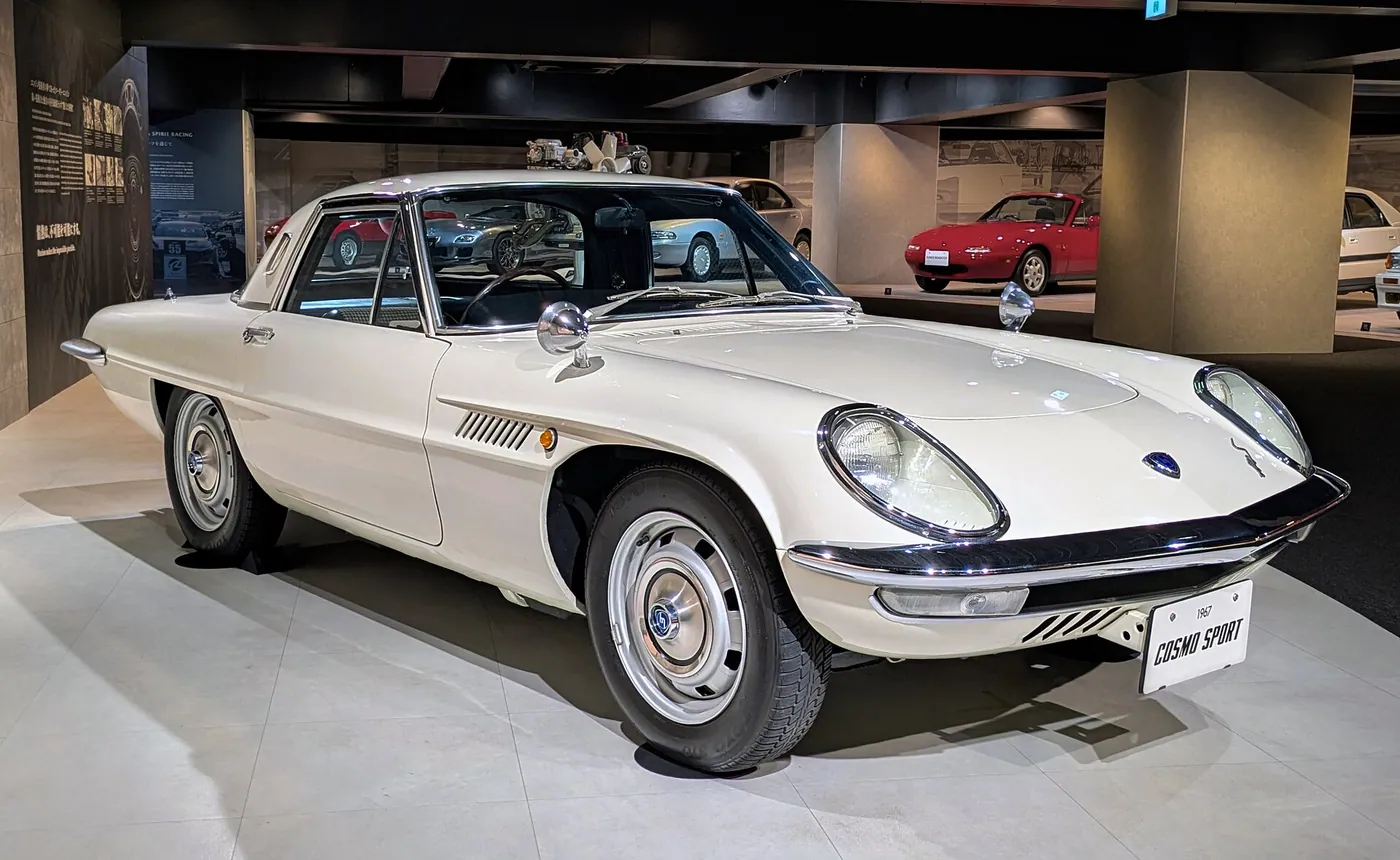
Versions worth knowing
The split is simple. The Series I is rarer and closest to the original concept. The Series II is the better car to drive, with more power, the five-speed gearbox and a longer wheelbase that improves ride and stability. Both are highly collectable, and with so few built, any honest example is significant.
What to check when buying in Japan
Cosmo Sports almost never appear in ordinary used-car auctions. Most change hands through specialist dealers and collectors, so careful verification matters more than ever. Confirm the chassis number, check it matches the documents and ask for the history of the car, including any restoration.
Rust attacks the sills, floor pans, the area around the rear screen, the boot floor and the lower edges of the doors and wings. Many cars have been restored, and quality varies. Body panels, glass and trim are very hard to find.
For the engine, a rotary compression test is essential. A correct test reads each rotor face, and low or uneven readings point to worn apex seals or side seals. Ask when the engine was last rebuilt and by whom. Some cars have had later Mazda rotary engines fitted, so confirm whether the car still has a correct 10A family engine. Mileage figures on a car of this age are rarely provable.
Should you import one?
The Cosmo Sport is a collector's car first. It suits someone who values historical importance and design, and who has access to rotary expertise. It is too rare and too valuable to be a daily driver, and it should be stored dry and used on fine days.
Every Cosmo Sport is far older than 30 years, so it can qualify for Ireland's vintage treatment. Owning one means becoming a custodian of a genuine landmark, the car that made Mazda's rotary reputation. For the right buyer, there are few more significant Japanese cars to own.
Frequently asked questions
Was the Cosmo Sport the first rotary car?
It was the world's first production car with a twin-rotor engine; NSU had earlier sold a single-rotor car.
What is the difference between Series I and Series II?
The Series II has 128 PS instead of 110 PS, a five-speed gearbox in place of the four-speed, and a wheelbase 150 mm longer.
How many Cosmo Sports were built?
Mazda built 1,176 in total: 343 Series I and 833 Series II cars.
What should be checked on the engine?
A proper rotary compression test reading every rotor face, plus evidence of rebuild history and confirmation that it is a correct 10A family engine.
More Japanese classics
- Honda S600: chain drive, 9,000 rpm and the birth of Honda the carmaker
- Honda S800: the 791 cc roadster that revved like a racing motorcycle
- Mazda Savanna RX-7 (SA22C): the light, pure sports car that rescued the rotary
- Mazda RX-7 (FC3S): the turbocharged rotary that grew up for the bubble years
- Mazda RX-7 (FD3S): the most beautiful rotary, and the most demanding to own
- All 90 Japanese classics you can import
Photo credits
- Photo: Joe deSousa / Wikimedia Commons, CC0
- Photo: Aos.1905 / Wikimedia Commons, CC BY 4.0