
Mazda Savanna RX-7 (SA22C): the light, pure sports car that rescued the rotary
After the oil crisis nearly sank Mazda's rotary dream, the first RX-7 brought it back with a lightweight, balanced coupe that won at Spa and sold in huge numbers.
By the Japan to Ireland editors · · 4 min read
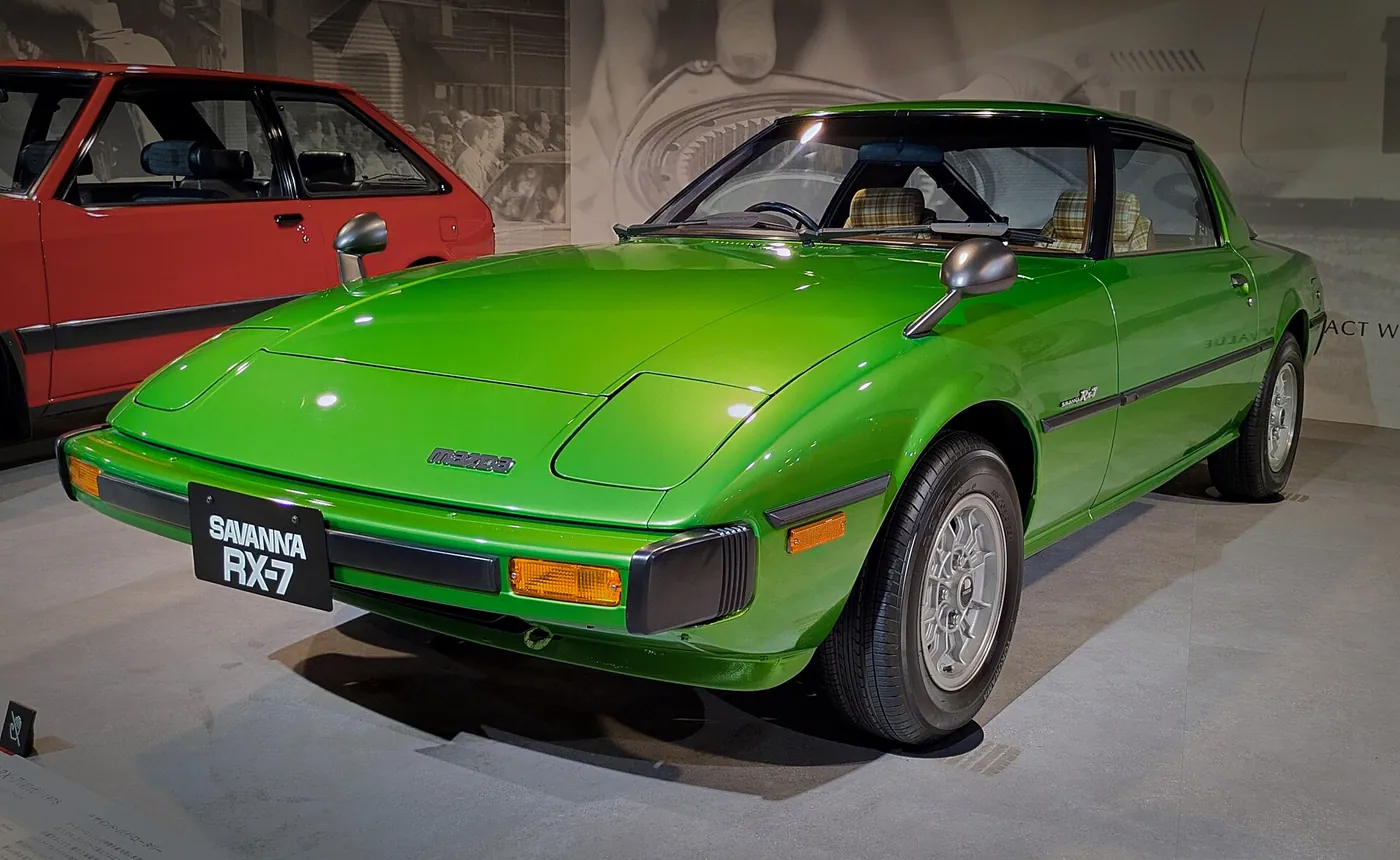
In 1973 the oil crisis hit Japan hard, and Mazda harder still. The company had staked its identity on the rotary engine, and rotary cars had a reputation for being thirsty. Sales collapsed in the United States, and Mazda needed support from its bankers to survive. Many in the industry assumed the rotary would quietly fade away.
Instead, in March 1978, Mazda launched the Savanna RX-7. It was a light, compact sports coupe with pop-up headlamps, a glass hatchback and a twin-rotor engine set well back behind the front axle. It was a hit at home and abroad, and it turned the rotary from a liability into the core of Mazda's sporting image.
The specs
| Years built | 1978–1985 |
|---|---|
| Engine | 1,146 cc twin-rotor (12A), turbo 12A from 1983 in Japan |
| Power | 130 PS (12A, Japanese gross rating), 165 PS (12A turbo, gross) |
| Gearbox | 5-speed manual, 3-speed automatic |
| Drive | Rear-wheel drive |
| Body styles | Three-door coupe with glass hatch |
| Layout | Front-mid engine, live rear axle with Watt's linkage |
| Production | More than 470,000 |
Why Mazda built it
After the oil crisis, Mazda launched a programme to make its rotary engines much less thirsty, and the improvements worked. The company then needed a car that showed off the engine's strengths: small size, low weight and smoothness. A sports car made perfect sense.
Japan in the late 1970s was recovering from the shocks of the decade and moving towards the prosperity of the 1980s. Emissions rules were tight, power outputs were modest, and the RX-7 offered drivers something special: a balanced, responsive car that felt alive at any speed.
Design and engineering
The SA22C is a model of simplicity. The 12A engine has two rotors totalling 1,146 cc and, in Japanese specification, was rated at 130 PS gross. Because the engine is so compact, Mazda could mount it behind the front axle line, giving the car near-even weight distribution and a low centre of gravity.
Front suspension uses MacPherson struts, and the rear is a live axle located by links and a Watt's linkage. It sounds basic, but it was carefully tuned and gives the car fine balance. Most cars have five-speed manual gearboxes, with a three-speed automatic also available.
Facelifts in 1980 and later brought integrated bumpers, revised lights and interior changes. In 1983 Mazda added a turbocharged 12A for the Japanese market, rated at 165 PS gross, which transformed performance. The RX-7 also proved itself in racing, winning the Spa 24 Hours in 1981 and taking many class wins in North America.
How it drives today
The first RX-7 feels light and honest. The steering is delicate and full of feedback, and the car turns in with very little effort. The engine is smooth and keen to rev, with a buzzing note that grows as you approach the limiter. In naturally aspirated form it is brisk rather than fast. The turbo is a different animal, quick enough to surprise many modern cars.
On an Irish back road, the balance is the joy. You can feel exactly what the car is doing, and it rewards smooth inputs. Modern safety and comfort features are missing, but ride quality is decent, and it copes with motorway cruising without fuss.
Versions worth knowing
The early pre-facelift cars have the purest look, with slim bumpers. The later cars are better developed and more common. The Japanese-market turbo of 1983 to 1985 is the most desirable for performance. Special editions and limited-run trim levels exist in Japan, though quality of condition matters far more than badges. Export markets also received a 13B-engined version, but Japanese cars generally carry the 12A.
What to check when buying in Japan
Rust is the main problem with any SA22C. Check the rear wheel arches, the sills, the floor pans, the rear chassis rails, the area around the hatch and windscreen and under the battery tray. Look for blistering paint, which often hides deeper corrosion.
The engine needs specific attention. Ask for a rotary compression test, which reads each rotor face and shows the condition of the apex seals. Low or uneven numbers mean a rebuild is coming. Check for smoke on start-up, rough idling and signs of flooding, and ask whether the oil metering system is original and working. Many cars have been modified with bridge-ported or peripheral-ported engines, 13B swaps or even different engines entirely, which can make them fun but far from original.
Service parts are still widely available, but some trim and body panels are scarce. Mileage on a car of this age is often unprovable. Make sure the chassis number matches the paperwork and that the Japanese export certificate is in order.
Should you import one?
The SA22C suits a driver who wants a classic sports car that is genuinely enjoyable to drive and not too fragile. It is more usable than earlier Japanese classics, and the rotary engine gives it a character no piston-engined rival can match.
Every SA22C is over 30 years old, so it can qualify for Ireland's vintage treatment. Expect to look after the engine carefully, use good oil, warm it up properly and avoid short trips. Keep the body dry and free of salt. Treated well, it is one of the most rewarding and affordable ways into Japanese classic ownership.
Frequently asked questions
What engine does the Japanese SA22C use?
Japanese cars use the 12A twin-rotor engine of 1,146 cc, with a turbocharged version offered in Japan from 1983.
Why is the first RX-7 so well balanced?
The compact rotary engine sits behind the front axle line, giving near-even weight distribution and a low centre of gravity.
What is the most important check before buying?
A proper rotary compression test reading each rotor face, along with a careful inspection for rust in the arches, sills and floors.
Did the RX-7 have racing success?
Yes, it won the Spa 24 Hours in 1981 and took many class wins in North American racing.
More Japanese classics
- Mazda Cosmo Sport 110S: the space-age coupe that proved the rotary engine
- Honda S600: chain drive, 9,000 rpm and the birth of Honda the carmaker
- Mazda RX-7 (FC3S): the turbocharged rotary that grew up for the bubble years
- Mazda RX-7 (FD3S): the most beautiful rotary, and the most demanding to own
- Eunos Cosmo: the three-rotor bubble-era coupe that showed Japan the future
- All 90 Japanese classics you can import
Photo credits
- Photo: Aos.1905 / Wikimedia Commons, CC BY 4.0