
Nissan Figaro: The 1991 Retro Convertible Ireland and the UK Fell in Love With
Built in a limited run and sold in Japan by lottery, the Figaro has become one of the best-loved Japanese imports in Ireland and the UK.
By the Japan to Ireland editors · · 4 min read
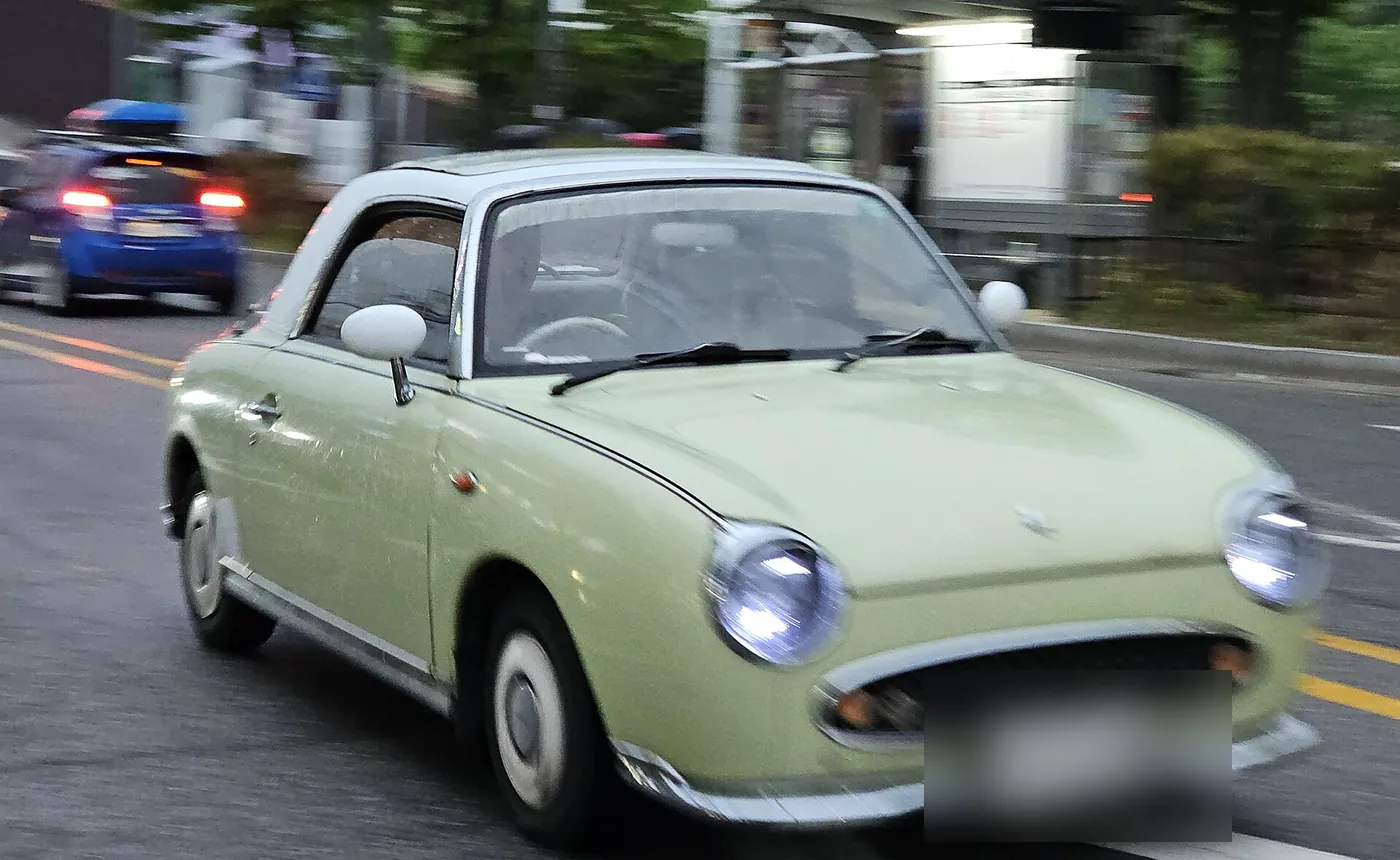
In 1991, Nissan launched a small convertible in Japan that looked like it had driven out of a 1960s film. With chrome trim, round headlamps, cream leather seats and a folding canvas roof, the Figaro was designed to evoke nostalgia rather than speed. Demand was so strong that Nissan sold it by lottery, and buyers waited to see whether their name would be drawn.
More than three decades later, the Figaro has become one of the most recognisable Japanese imports on Irish and British roads.
The specs
| Years built | 1991 |
|---|---|
| Engine | 1.0-litre four-cylinder turbo (MA10ET) |
| Power | 76 PS |
| Gearbox | 3-speed automatic |
| Drive | Front-wheel drive |
| Body styles | 2+2 convertible with fixed side frames and folding roof |
| Production | 20,000 |
| Base | Nissan Micra (K10) |
Why Nissan built it
In the late 1980s, Nissan set up a small group, often called the Pike Factory, to create limited-production retro cars based on existing models. The first was the Be-1 in 1987, followed by the Pao and the S-Cargo. These cars sold strongly in Japan during the bubble economy, when buyers were eager for distinctive, stylish products. They were a reaction against the angular, digital design language of the 1980s. Where most new cars of the period had wedge shapes and electronic dashboards, the Pike cars offered curves, chrome and a sense of humour.
The Figaro was the fourth and most luxurious of these cars. It was shown at the 1989 Tokyo Motor Show and went on sale in 1991. Nissan planned an initial run of 8,000 cars but increased production to 20,000 in response to demand.
Design and engineering
The Figaro is based on the first-generation Nissan Micra, known as the K10. It uses a 1.0-litre turbocharged four-cylinder engine with 76 PS, paired with a three-speed automatic gearbox. The car was designed for gentle cruising rather than performance.
The body has fixed side frames, with a folding canvas roof and a rear section that folds to open the car fully. Inside, the Figaro has cream leather seats, chrome-ringed dials and a retro-styled dashboard with a CD player and air conditioning. It was offered in four colours, Emerald Green, Pale Aqua, Lapis Grey and Topaz Mist, each said to represent a season.
The details reward a close look. The switchgear is styled to look older than it is, the steering wheel has a thin, retro rim, and the small rear seats are best suited to bags or children. The boot is modest, but the car was never meant to be a load carrier. It was meant to make its owner smile on the way to lunch.
How it drives today
The Figaro is gentle and relaxed. The turbo engine provides enough performance for town and country driving, but the three-speed automatic makes motorway cruising noisy. Steering is light, the ride is soft, and the car is easy to park.
On Irish roads, it is best suited to town driving, coastal routes and Sunday drives. It is not a sports car, but it is a delight to drive with the roof open on a sunny day. With the roof closed and the heater running, it copes well with an Irish winter, provided the seals are in good order. Its compact size also makes it easy to live with in a city such as Dublin or Cork, where parking spaces are tight.
The versions worth knowing
All Figaros were built in 1991, with only minor differences between them. The four original colours are the main distinction, and Topaz Mist is often said to be the rarest. Many cars in Ireland and the UK have been repainted, sometimes in non-original colours, and some have been fitted with upgraded parts. For an enthusiast, a car in one of its original colours with the original interior is the one to seek out. For a buyer who simply wants a usable, pretty car, a well-maintained repainted example can be a sensible choice.
What to look for when buying one in Japan
Rust is the main concern. Check the sills, floor, wheel arches, the area around the rear window and the boot floor. The folding roof and its seals can leak, leading to damp carpets and hidden corrosion. Check the roof mechanism, the canvas and the rear window section for damage.
Check the engine for oil leaks and the turbo for smoke. The three-speed automatic gearbox should change smoothly. Air conditioning systems on older cars often need attention.
Many Figaros have been restored, repainted or modified. Original paint, interior and trim are desirable. Parts availability is reasonable for mechanical components, as the Figaro shares much with the Micra, but some trim and body parts are scarce. The strong following in the UK and Ireland means there are specialists and owners' clubs that can help.
Mileage claims should be treated with caution. Look at condition and the auction sheet. Make sure the export paperwork matches the chassis number.
Should you import one?
The Figaro suits a buyer who wants a stylish, gentle classic for relaxed driving. It is a car for sunny days, weddings and coastal drives, not a daily commuter in heavy traffic.
In Ireland and the UK, the Figaro already has a following, with owners' clubs and specialists who know the car well. It is right-hand drive and easy to drive. All Figaros are now over 30 years old and can qualify for Ireland's vintage treatment. Expect a charming, characterful car that needs rust prevention and careful maintenance but will make every trip feel special.
Frequently asked questions
How many Nissan Figaros were built?
Nissan built 20,000 Figaros in 1991, after increasing production from an initial plan of 8,000.
What engine does the Figaro have?
A 1.0-litre turbocharged four-cylinder with 76 PS, paired with a three-speed automatic gearbox.
Are Figaro parts hard to find?
Mechanical parts are reasonably available because the car is based on the Micra, but some trim and body parts are scarce.
Is there a Figaro following in Ireland?
Yes. The Figaro is popular in Ireland and the UK, with owners' clubs and specialists who know the car well.
More Japanese classics
- Suzuki Carry Truck: Six Decades of Japan's Toughest Little Workhorse
- Suzuki Alto Works: The Little Hatch That Set Japan's 64 PS Kei Car Limit
- Nissan Pao: The Safari-Styled City Car Built Only for Those Who Ordered in Time
- Nissan Be-1: the little retro hatchback that taught Nissan to sell nostalgia
- Nissan S-Cargo: the snail-shaped delivery van that became a design icon
- All 90 Japanese classics you can import
Photo credits
- Photo: Damian B Oh / Wikimedia Commons, CC BY-SA 4.0