
Nissan S-Cargo: the snail-shaped delivery van that became a design icon
A tiny commercial van shaped like a snail shell, named after a French pun, the S-Cargo is one of the oddest and most loved vehicles of Japan's bubble years.
By the Japan to Ireland editors · · 4 min read
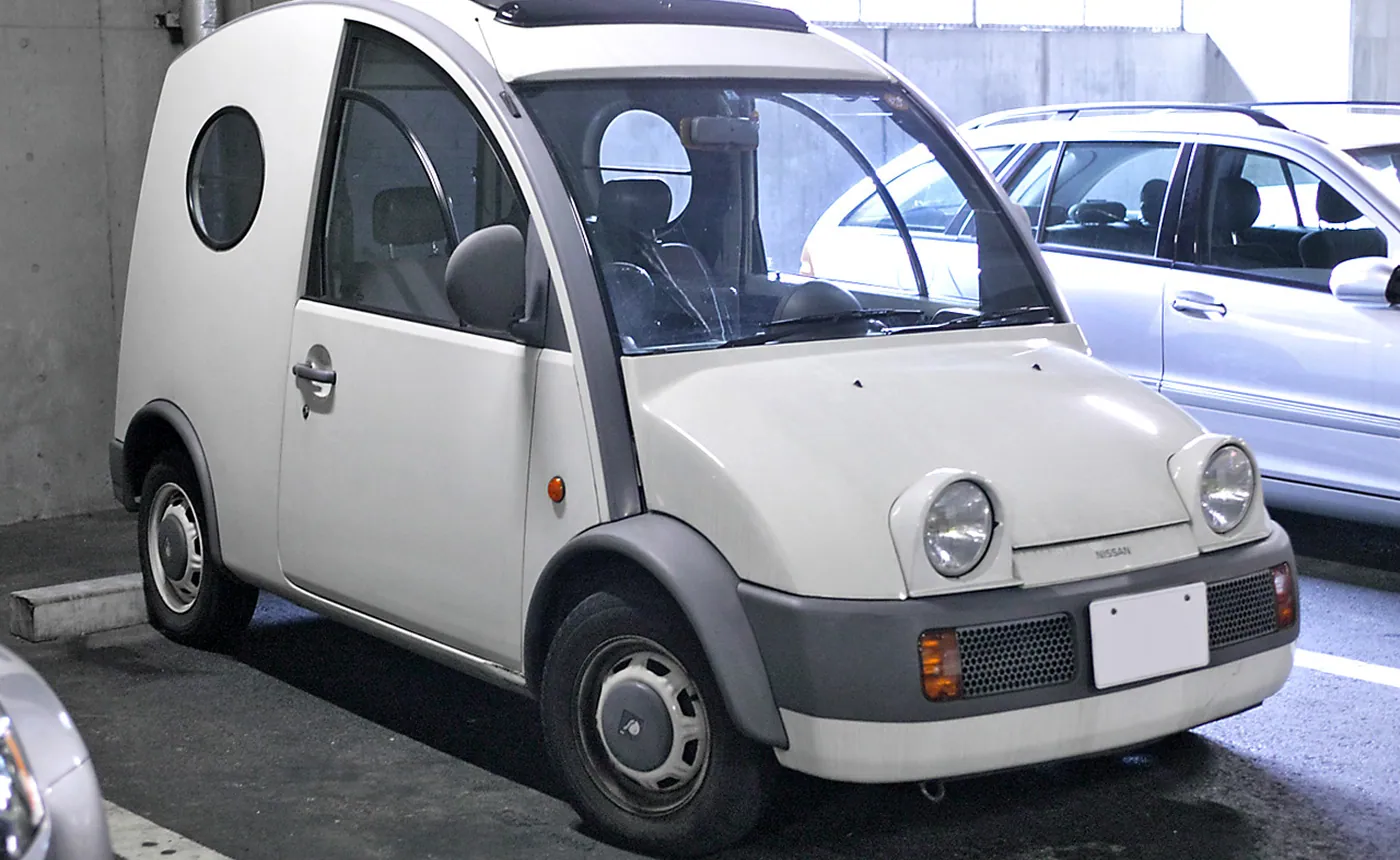
Picture a narrow Tokyo street at the end of the 1980s. Delivery vans are everywhere, boxy and white and entirely forgettable. Then one turns the corner that looks like a snail. It has a tall domed roof that curves down at the back, a single round headlamp on each side of a small face, and a large flat panel on its flank that is begging for a shop's name. That was the point.
The S-Cargo was built for small businesses that wanted their van to be an advertisement. Its name is a pun: say it aloud and you get escargot, the French word for snail. It is not a sports car, a luxury car or even a particularly practical van. It is a piece of design, and it is one of the purest expressions of the confidence that ran through Japan in its bubble economy years.
The specs
| Years built | 1989–1992 |
|---|---|
| Base | Nissan Sunny and Pulsar family |
| Engine | 1.5-litre E15 four-cylinder petrol |
| Gearbox | 3-speed automatic |
| Drive | Front-wheel drive |
| Body styles | 2-seat van, canvas-top van |
| Family | Nissan Pike cars (Be-1, Pao, S-Cargo, Figaro) |
Why it was built
By the time the S-Cargo was shown at the Tokyo Motor Show in 1987, Nissan had already seen the Be-1 sell out. The company had learned that a carefully styled, limited-production car built on existing mechanicals could draw crowds and make money. The Pao followed in 1989 and the S-Cargo arrived the same year. Together with the Figaro of 1991, these became known as the Pike cars.
The S-Cargo was different from its siblings because it had a working purpose. Florists, cafés and boutiques bought them as rolling signs. The wide, flat side panels and round rear door were ideal for lettering. Production was handled by an outside contractor, and the van was sold for a few years only, which is why it remains scarce.
Design and engineering
Mechanically, the S-Cargo draws on the Sunny and Pulsar family of the time. The engine is a 1.5-litre E-series four-cylinder, mounted across the front and driving the front wheels. The only gearbox offered was a three-speed automatic, which tells you exactly what kind of driving Nissan had in mind: town deliveries, not open roads.
The body is where all the effort went. The roof rises high above the cabin and curves down to a rounded rear. There is a porthole-style side window option, a canvas sunroof on some versions and a cabin with two seats and a large load area behind. Inside, the dashboard has a central instrument pod and simple controls with a playful, rounded design.
How it drives today
Slowly and with personality. The engine has enough power to keep up with city traffic, but the three-speed automatic and the tall, slab-sided body mean motorway speeds feel effortful and noisy. A strong gust on an open road will push the van around, so it is best treated as a town and suburb vehicle.
In its natural habitat it is easy to drive. The seating position is upright, the view out is good and the steering is light. Irish buyers should think of it as a small café or market van, or a weekend car with a sense of humour, rather than a daily commuter on the N7.
The versions worth knowing
There were two main body variants: the standard fixed-roof van and a version with a canvas roof panel. Some vans were fitted with the round porthole side windows, which have become one of the most recognisable details. Many survivors still carry traces of their working lives, including old signwriting, roof racks or fitted shelving.
What to check when buying one in Japan
Rust is the first thing to look for. The floor, sills, the lower edges of the doors, the rear door frame and the wheel arches are vulnerable, and many vans worked hard in coastal or snowy regions. Canvas-top versions need the fabric, seals and drain tubes checked, because trapped water rots the floor. Commercial use also means interior wear, so expect scuffed load areas and tired seats.
The engine and gearbox are shared with mass-produced Nissans and many service parts can still be found. Model-specific items are another story. Lamps, the porthole glass, bumpers, interior trim and badges can be very difficult to source, so a complete van in honest condition is better than a cheaper one with missing pieces.
Mileage is often hard to verify on a former commercial vehicle. Look for consistent service records and an auction history that makes sense. Original paint is worth paying attention to, as some vans have been repainted in colours that were never offered. Make sure the export certificate and registration paperwork are complete.
Should you import one?
The S-Cargo suits someone who wants a vehicle that people will smile at, and perhaps a small business that wants a memorable van for markets and events. It is right-hand drive, compact and easy to park, and its mechanicals are simple. It will not suit anyone who needs to cover long motorway distances regularly.
Store it under cover, keep the drains clear and treat the body with rust protection. Cars over 30 years old can qualify for Ireland's vintage treatment, and the earliest S-Cargos have already reached that age. Expect the occasional delay in sourcing trim parts, and buy the most complete example available. Few vehicles on Irish roads will draw as many questions at a petrol station.
Frequently asked questions
Why is it called the S-Cargo?
The name is a pun on escargot, the French word for snail, which matches the van's shell-like shape.
Is the S-Cargo automatic only?
Yes. It was sold with a three-speed automatic gearbox and front-wheel drive.
Can it be used as a working van in Ireland?
It can carry light loads and was designed for small businesses, but it is best suited to short trips and town use.
Are parts difficult to find?
Engine and gearbox parts are shared with mainstream Nissans, but body panels, lamps and trim are scarce.
More Japanese classics
- Nissan Be-1: the little retro hatchback that taught Nissan to sell nostalgia
- Nissan Pao: The Safari-Styled City Car Built Only for Those Who Ordered in Time
- Nissan Silvia (S13): the bubble-era coupé that became the world's drift car
- Nissan 180SX: pop-up headlamps, a turbo and a ten-year run in Japan
- Nissan Pulsar GTI-R: the pocket rally car with a Skyline-style four-wheel drive
- All 90 Japanese classics you can import
Photo credits
- Photo: Tennen-Gas / Wikimedia Commons, CC BY-SA 3.0