
Nissan Silvia (S13): the bubble-era coupé that became the world's drift car
Launched in 1988 as a stylish, affordable rear-wheel-drive coupé, the S13 Silvia won Japan's Car of the Year and then found a second life on drift circuits. Finding an unmodified one is now the challenge.
By the Japan to Ireland editors · · 4 min read
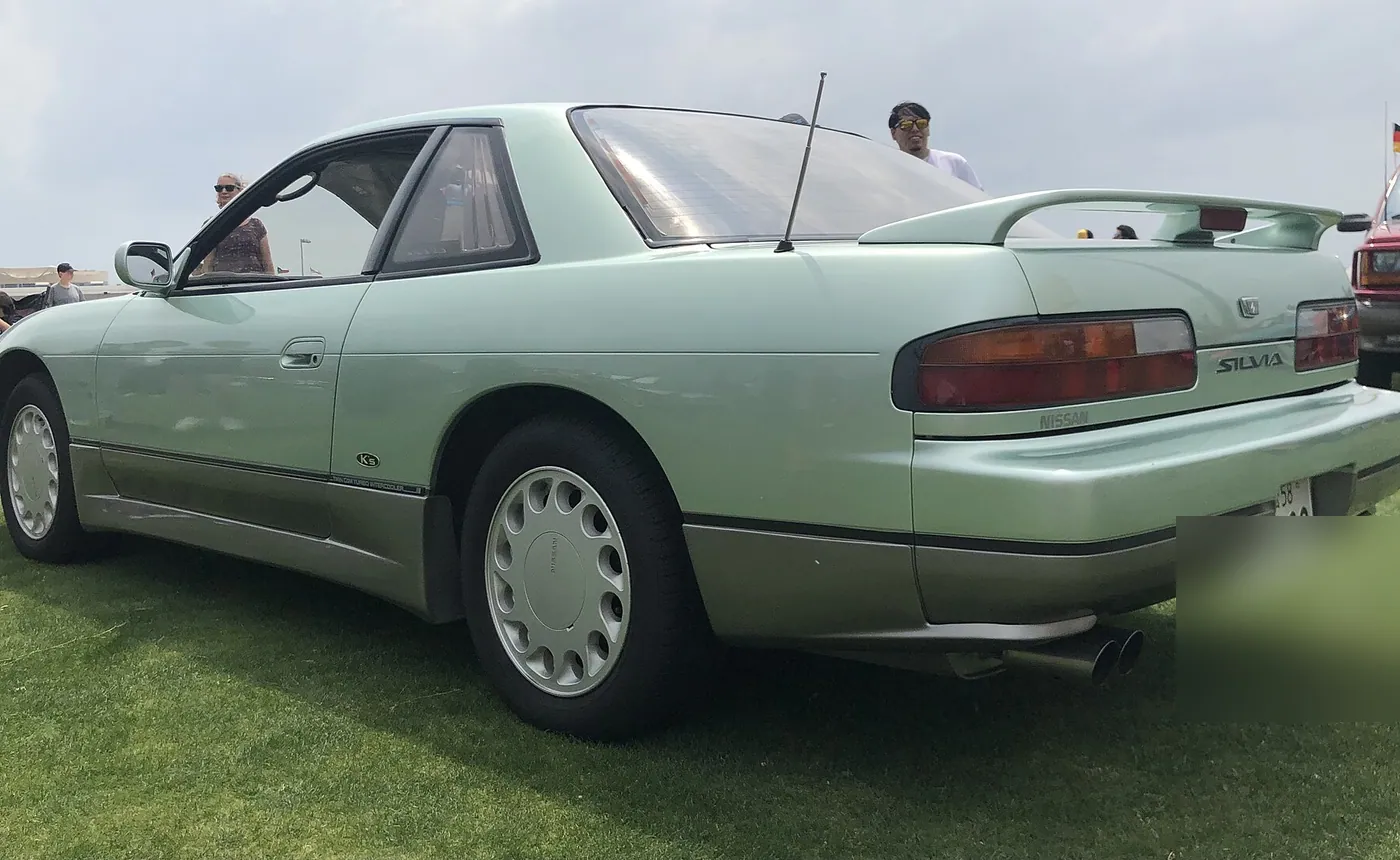
In May 1988 Nissan unveiled a coupé that looked nothing like the angular cars it had been selling for most of the decade. It was low and smooth, with a long bonnet, a short tail and slim headlamps. Its advertising leaned on design and style rather than performance figures. Within months it was named Japan Car of the Year. It was the S13 Silvia.
Few people at the time imagined that this tidy coupé would become one of the most important cars in modern motorsport culture. Yet the qualities that made it a good road car, rear-wheel drive, light weight, a balanced chassis and a strong turbocharged engine, also made it ideal for sliding sideways. Today the S13 is a drift icon, and that shapes everything about buying one.
The specs
| Years built | 1988–1993 |
|---|---|
| Engine | 1.8-litre CA18DE/CA18DET, later 2.0-litre SR20DE/SR20DET |
| Power | About 175 PS for CA18DET, 205 PS for SR20DET |
| Gearbox | 5-speed manual or 4-speed automatic |
| Drive | Rear-wheel drive |
| Body styles | 2-door coupé; small-run convertible |
| Trim names | J's, Q's, K's |
Why it was built
Japan in 1988 was deep in the bubble economy. Young buyers had money, and the market was crowded with sporty coupés, most notably the Honda Prelude. Nissan wanted a stylish two-door that would appeal to buyers who cared about how a car looked as much as how fast it was. The S13 was the answer, and it was an enormous success in Japan.
Crucially, Nissan kept rear-wheel drive when many rivals had moved to front-wheel drive. That decision is the root of the car's later reputation.
Design and engineering
The S13 uses MacPherson struts at the front and a multi-link rear suspension, which was advanced for a car in its class. A four-wheel steering system called HICAS was an option. Engines in the early cars were the 1.8-litre CA18 twin-cam, offered with or without a turbocharger. In 1991 Nissan replaced it with the 2.0-litre SR20, again with or without a turbo. The turbocharged SR20DET is the most desirable engine and is famous for its strength and tuning potential.
The trim levels have playing-card names: J's for the entry model, Q's for the mid-range car and K's for the turbo. Projector headlamps were fitted to some versions and are one of the details that distinguish the S13 from its sibling, the pop-up-headlamp 180SX. A convertible was built in a small run by Nissan's Autech division, though it is rarely seen.
How it drives today
A good S13 feels light, alert and communicative, with steering that tells you what the front tyres are doing and a rear end that can be adjusted with the throttle. The turbo cars are quick by modern standards for their size, with a surge of power in the mid-range. The non-turbo cars are less dramatic but still pleasant and balanced.
On wet Irish roads a rear-wheel-drive turbo car with no electronic aids demands respect. Good tyres, sensible use of the throttle and a well-maintained limited-slip differential, where fitted, make a big difference. On a dry back road in Wicklow or Kerry, the S13 is a joy.
The versions worth knowing
The early CA18DET K's and the later SR20DET K's are the cars most buyers want. The non-turbo Q's is a sensible, lower-stress alternative. The J's is the simplest model. The Autech convertible is a curiosity for collectors. Many cars have been converted with parts from other S-chassis Nissans, so check carefully what you are looking at.
What to check when buying one in Japan
The biggest issue with the S13 is modification. A very large proportion of surviving cars have been used for drifting or street driving. Look for welded differentials, aftermarket coilovers, cut or rolled arches, uprated turbos, removed interior trim, roll cages, damaged bumpers and evidence of hard use. An auction sheet that lists many modifications is a warning to look closer, not a selling point.
Accident damage is common, particularly to front ends and rear quarters, so check panel gaps and look for signs of repair under the carpets and in the boot. Rust appears in the rear arches, sills, strut tops and around the boot floor. Engine swaps are frequent, and a car with a different engine from the one it left the factory with may raise questions with insurers and at the NCT.
Mileage on modified cars is especially difficult to trust. Prioritise cars with consistent records and as much original equipment as possible. Make sure the Japanese export certificate and paperwork match the car's chassis number.
Should you import one?
An S13 suits an enthusiast who values driving feel, understands older turbo cars and is prepared for the work of maintaining one. It is right-hand drive and naturally at home on Irish roads. Insurance for a turbocharged car with a drift reputation can be the biggest hurdle, so get a quote before you buy.
A clean, original S13 is now rarer than a modified one and is the better long-term choice. Cars over 30 years old can qualify for Ireland's vintage treatment, and the early S13s have reached that age. Expect to spend time sourcing good parts and finding a mechanic who knows these engines. Buy carefully and you will own one of the defining cars of its era.
Frequently asked questions
What is the difference between the S13 Silvia and the 180SX?
They share the same platform, but the Silvia is a notchback coupé with fixed headlamps while the 180SX is a hatchback with pop-up headlamps.
Which engine should I look for?
The turbocharged SR20DET in the later K's is the most sought after, while the CA18DET in the earlier K's is also strong.
Are most S13s modified?
Many are, because of the car's drifting popularity. An original, unmodified car is harder to find and worth more effort.
Is insurance difficult in Ireland?
It can be, because of the car's age, turbo engine and reputation. Get quotes before committing.
More Japanese classics
- Nissan S-Cargo: the snail-shaped delivery van that became a design icon
- Nissan Be-1: the little retro hatchback that taught Nissan to sell nostalgia
- Nissan 180SX: pop-up headlamps, a turbo and a ten-year run in Japan
- Nissan Pulsar GTI-R: the pocket rally car with a Skyline-style four-wheel drive
- Nissan Cedric and Gloria (Y31): the twin saloons that carried Japan's businessmen
- All 90 Japanese classics you can import
Photo credits
- Photo: TKOIII / Wikimedia Commons, CC BY 4.0