
Toyota Celica GT-Four (ST165): The First Turbocharged, Four-Wheel-Drive Celica Goes Rallying
Toyota's first serious answer to the four-wheel-drive revolution in rallying was also a refined, quick road car. It laid the foundation for a world championship decade.
By the Japan to Ireland editors · · 4 min read
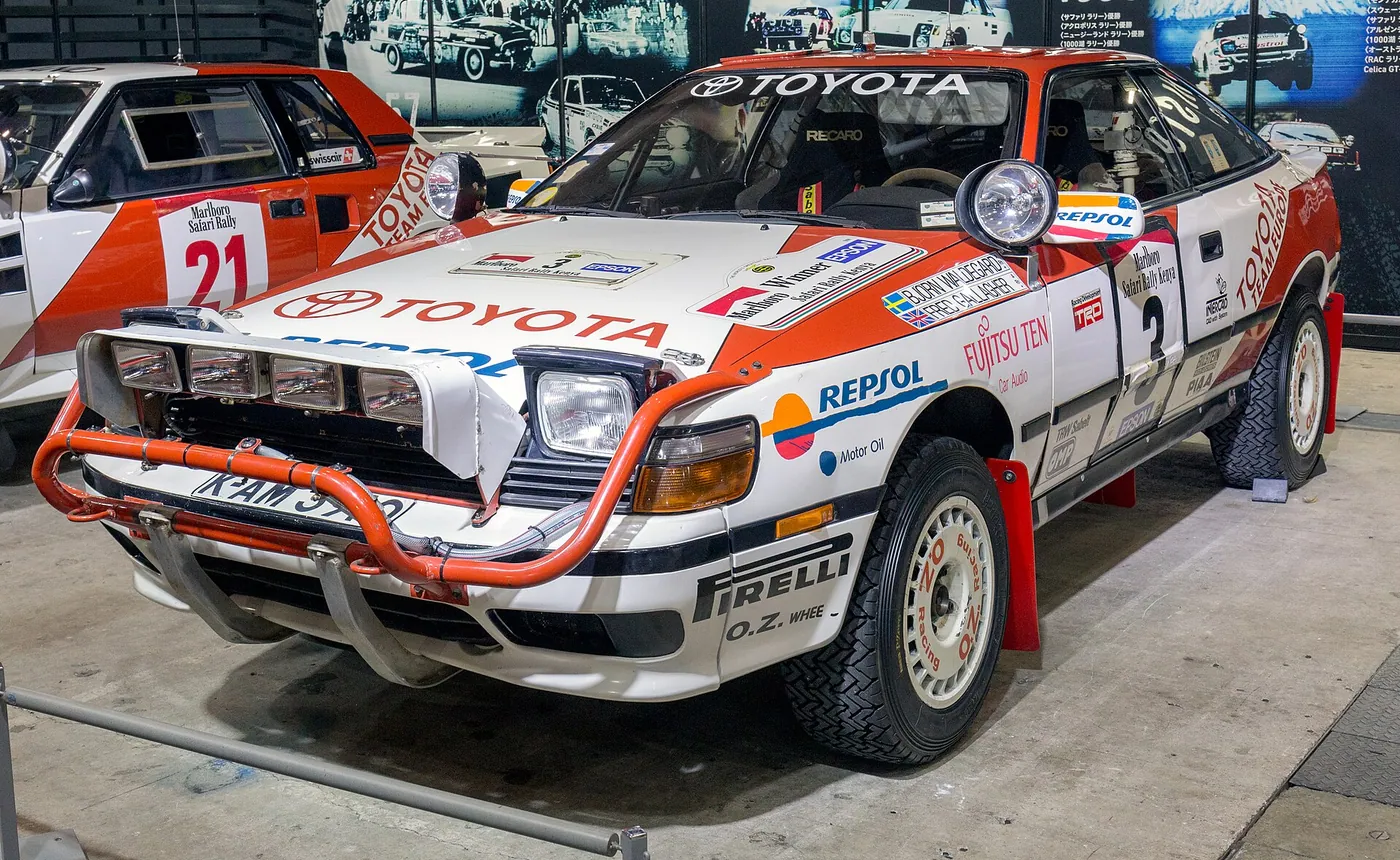
In the middle of the 1980s, world rallying went through a violent change. Audi had shown, with the Quattro, that four-wheel drive was the future. The fearsome Group B cars that followed were banned after the 1986 season, and the championship moved to Group A, which required cars to be based closely on road models built in large numbers. Every manufacturer who wanted to win now needed a turbocharged, four-wheel-drive road car to start from.
Toyota's answer arrived in Japan in October 1986. The Celica GT-Four took the new front-wheel-drive fourth-generation Celica, added a turbocharged two-litre engine and full-time four-wheel drive, and created a car that could be sold in showrooms and developed into a rally weapon.
The specs
| Years built | 1986–1989 |
|---|---|
| Engine | 2.0 3S-GTE turbocharged four-cylinder |
| Power (Japan) | 185 PS |
| Gearbox | 5-speed manual; automatic offered in Japan |
| Drive | Full-time four-wheel drive |
| Body styles | Three-door liftback |
| Chassis code | ST165 |
A Celica turned inside out
The fourth-generation Celica, launched in 1985, had already broken with tradition. Earlier Celicas had been rear-wheel drive. The new car was front-driven, smoothly styled and aimed at a wider market. Building a four-wheel-drive version meant fitting a centre differential, a propshaft and a rear differential into a car never originally designed for them.
The engine was the 3S-GTE, a two-litre twin-cam four-cylinder with a turbocharger and an intercooler. In Japanese specification it produced 185 PS. The four-wheel-drive system used a centre differential to split drive between the front and rear axles. Japanese buyers could also choose an automatic GT-Four, which used a different, electronically controlled arrangement.
The ST165 was a product of a Japan at the height of its confidence. The economy was surging, the bubble was inflating and Japanese makers were taking on Europe in motorsport, design and engineering. The GT-Four was part of that story.
The rally car
The ST165 was developed into a Group A car by Toyota Team Europe, based in Cologne. It took its first world championship win in 1988 and grew into a front-running car. In 1990 Carlos Sainz won the World Rally Championship drivers' title in an ST165, the first time a Japanese manufacturer's car had carried a driver to that title. The groundwork it laid led directly to the ST185 and Toyota's championship years in the early 1990s.
How it drives today
On the road the ST165 is less dramatic than its rally career suggests. It is a refined, comfortable liftback with a firm but manageable ride. There is noticeable turbo lag by modern standards, followed by a strong mid-range surge. The four-wheel drive gives it remarkable traction on damp roads, which matters in Ireland more than almost anywhere.
It feels its age in the steering and brakes, which are adequate but not modern. Driven within its limits, it is a fast, secure car for wet, twisting roads. It can still embarrass newer machinery on a greasy B-road.
The versions worth knowing
Japanese-market cars are the main source. Most are manuals, though automatic GT-Fours appear. Some Japanese cars have the optional digital instrument cluster and other electronic features that were fashionable at the time, so check that these still work.
Toyota also sold the fourth-generation Celica with other engines and front-wheel drive in Japan, including a convertible. Those are different cars, so check the chassis code is ST165 before going any further. Export markets received their own versions, sometimes with slightly different specifications, but Japan remains the deepest pool.
What to check when buying one in Japan
Rust is a real concern. Look at the rear wheel arches, the sills, the floor around the rear suspension, the spare-wheel well and the bottom of the tailgate. A car from a snowy region is more likely to have suffered underneath.
The 3S-GTE is a strong engine when looked after, but many have been tuned, and the turbo and its oil feed need careful inspection. Check for blue smoke, listen for turbo whine or rattles, and look for oil leaks. The four-wheel-drive system should feel smooth; clunks and vibrations on full lock or under load suggest worn joints or a tired centre differential.
Many ST165s have been modified. Some have aftermarket boost controllers, exhausts or suspension. As with all cars of this age, the stated mileage should be treated with healthy suspicion and checked against service history and wear. Some mechanical parts are shared with other Toyotas, but body panels, trim and interior parts are increasingly difficult to find.
Should you import one?
The ST165 is for a buyer who wants a piece of rally history that is still usable, practical and secure in Irish conditions. It is a four-seat liftback with a useful boot, and the four-wheel drive makes it more relevant to wet Irish roads than most classic performance cars.
All ST165s are now over 30 years old, which can qualify them for Ireland's vintage treatment. That makes it a realistic weekend car or occasional runabout. Expect to deal with rust protection, a steady supply of small repairs and the occasional hunt for scarce parts. Choose the most original example you can, with clear history and as little tuning as possible. Treated well, it is one of the most rewarding classic performance cars Japan produced.
Frequently asked questions
Is the ST165 GT-Four four-wheel drive?
Yes. It has full-time four-wheel drive with a centre differential, and a turbocharged two-litre engine.
Did the ST165 win a world rally title?
Yes. Carlos Sainz won the 1990 World Rally Championship drivers' title in an ST165.
Are all fourth-generation Celicas GT-Fours?
No. Most were front-wheel drive with other engines. Check the chassis code is ST165.
What are the main rust areas on an ST165?
The rear arches, sills, rear floor, spare-wheel well and the bottom of the tailgate.
More Japanese classics
- Toyota AE86 Levin and Trueno: The Humble Corolla That Taught the World to Drift
- Toyota Supra (A80): The Grand Tourer That Became a Legend by Accident
- Toyota Celica GT-Four (ST185): Toyota's World Champion in a Wide, Muscular Coupe
- Toyota Celica (TA22): The Coupe That Gave Japan's Young Drivers a Choice
- Toyota MR2 (AW11): Japan's First Mass-Produced Mid-Engined Car Still Feels Like a Revelation
- All 90 Japanese classics you can import
Photo credits
- Photo: Morio / Wikimedia Commons, CC BY-SA 4.0